


Morgan Stanley posted $20.3bn of net revenue for the third quarter and a 22.6% return on tangible common equity. The secondaries story sat in a single answer on the call. Asked by an analyst why the backlog of sponsor mandates has been “more of a waiting game for the last couple of years”, CEO Ted Pick gave two answers, and the second was the more candid.
There are some sponsors in the universe that are stuck on marks and marks that are just not going to come to pass
Ted Pick, Chairman and CEO, Morgan Stanley (3Q26 earnings call)
Pick tied the point to pricing discipline. Buyers, he said, are very sharp to what sits in sponsors' portfolios and to the new weighted average cost of capital regime, including country, supply-chain and AI risk. Some sponsors, he added, are holding on and hoping for better.

The positive answer names continuation funds
Pick opened with the view that at some point, the piper must be paid, meaning portfolios have to be harvested. He then listed what sponsors have done instead of selling: there's been, of course, a ton of engineering, continuation funds, the ability to put some assets in new funds.
He also gave the hold-longer case a fair hearing. Some private equity investors, he said, have decided they want to keep certain assets on their balance sheet because those businesses work at higher rates and can generate low to mid-double-digit IRRs with appropriate leverage.
He credited the leading firms with mixing exits, bringing some stuff that maybe doesn't have a higher mark, but it's ready for prime time to market alongside clear winners.
No rate rescue in the base case
The comments that matter most for pricing were about the macro backdrop. Pick called it a longer odds bet that the market gets a low-rate, low-inflation, non-recessionary environment, and said he would not bet on it. Sponsors waiting for that outcome to validate their marks are, in his framing, waiting on the less likely scenario.
He also revised his own call. Pick said he may have been mistaken a couple of years ago in expecting sponsors to lead the corporate finance cycle. Corporates are leading it instead, and sponsors have to hustle to keep up with the strategic bid.
Elsewhere on the call, he said that when higher rates reflect inflation or supply shocks rather than growth, investors become less excited about putting up illiquid risk capital.
September narrowed the window
The numbers show a quarter split in two. Management described July and August as brisk, before Middle East tensions and higher global rates slowed activity around Labor Day. Equity underwriting fell 19% year on year to $525m on lower IPOs and blocks, partially offset by follow-ons. Firm-wide investment banking revenue fell 11% from the second quarter. Wells Fargo's Mike Mayo referred to pulled IPOs in his question.
Advisory was the exception, up 30% to $887m on higher completed M&A in the Americas. That fits Pick's point that corporates, not sponsors, are setting the pace.
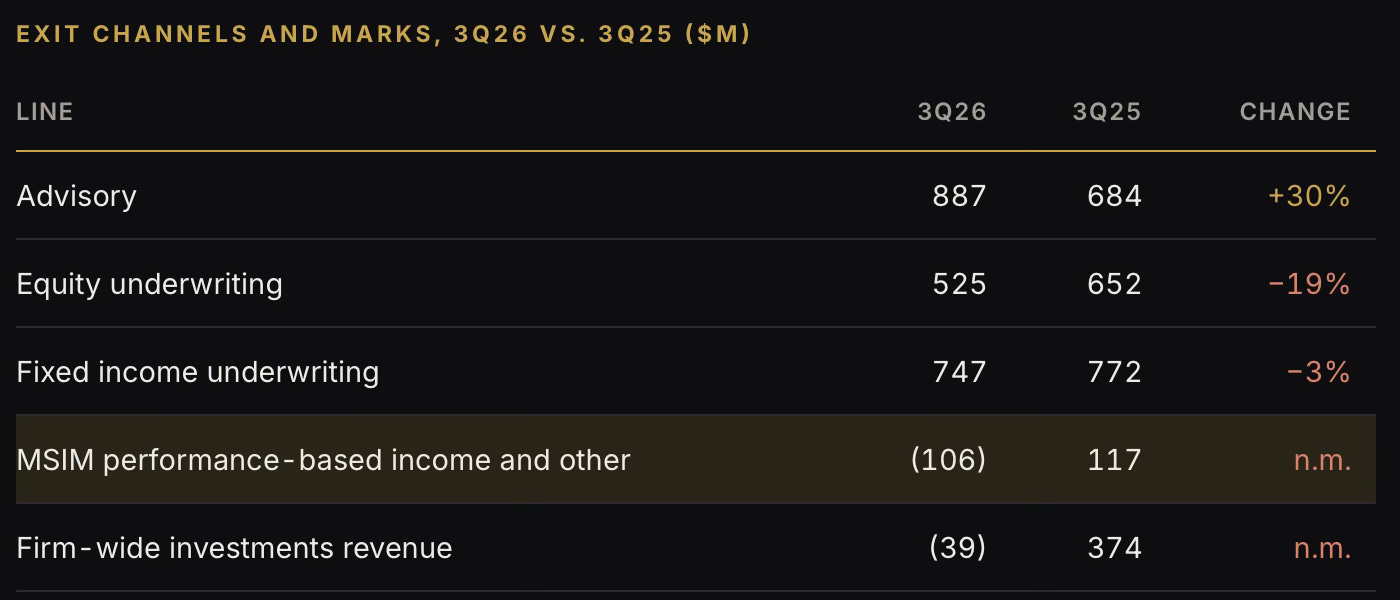
Source: Morgan Stanley 3Q26 earnings release and consolidated income statement. Percentage changes calculated by Secondary Scoop.
Morgan Stanley took a mark of its own
Morgan Stanley Investment Management reported performance-based income and other revenue of $(106)m, against $117m a year earlier. The release attributes the swing to the reversal of accrued carried interest related primarily to certain investments in one of our private funds. On the call, management described it as related to two investments in a private fund. Neither names the fund or the assets. IM net revenue fell 12% to $1.5bn, and IM compensation fell on lower carry-related pay.
Where distributions go when they come
The wealth business shows the other end of the liquidity chain. Just over half of the record $232bn in net new assets was IPO-related. Management described how fund distributions after lockups expire, and stock received by investors such as endowments, move into Morgan Stanley advice accounts. Alternatives delivered another quarter of record sales in wealth, and Pick said parts of the firm's alternatives platform, in both product and pricing, aren't available to clients anywhere else.
When exits do happen, some of the proceeds go back into wealth channels, where semi-liquid private markets products are sold.