


PitchBook reported this week that the Teacher Retirement System of Texas (TRS) sold an approximately $1bn portfolio of private equity fund interests, according to people familiar with the matter. Coller Capital, which has operated as Coller EQT since EQT closed its acquisition of the firm on August 31, took all or most of the portfolio. The deal closed in June. Jefferies ran the process.
Public filings show that the assets sold included a stake in EQT VII, EQT’s 2015-vintage flagship buyout fund. Pricing and the discount to NAV have not been disclosed. TRS, Coller EQT and Jefferies have not commented on the record.
What TRS said in 2024
In July 2024, the TRS board cut the system’s long-term private equity target from 14% to 12%. At the end of March 2024, TRS held $33.7bn of private equity, or 16.7% of a then-$202bn portfolio. It was already over its old target before the new one took effect. Getting to 12% meant shedding roughly $9.7bn of exposure.
The plan at the time was to get there passively. At the July 2024 board meeting, Neil Randall, TRS’s head of private equity, said the pension did not plan to use secondary sales to reach the lower target, according to contemporaneous reporting by Bloomberg and the Dallas Morning News. Instead, TRS would stop writing large checks to big buyout funds and concentrate new commitments on smaller middle-market managers. Bloomberg reported that the transition would begin that October and take several years.
Passive rebalancing depends on distributions. When distributions stall, the overweight stays put.
Why the plan changed
The passive route relies on two things moving at once: new commitments slow, and existing funds return capital. TRS controlled the first. It did not control the second.
At December 31, 2024, the latest figure we can verify, TRS was still at 15.7% in private equity against the 12% long-term target. That is a percentage point lower than nine months earlier, with more than three points still to go. Strong public market returns also work against a pension in this position. TRS returned 15.9% in calendar 2025, which lifts the denominator but does nothing to accelerate exits in the numerator.
A $1bn sale covers only around a tenth of the original $9.7bn gap. But it shows the system is now willing to use the secondary market, which it explicitly ruled out two years ago. We do not have TRS’s current private equity weight, and TRS has not said whether further sales are planned.
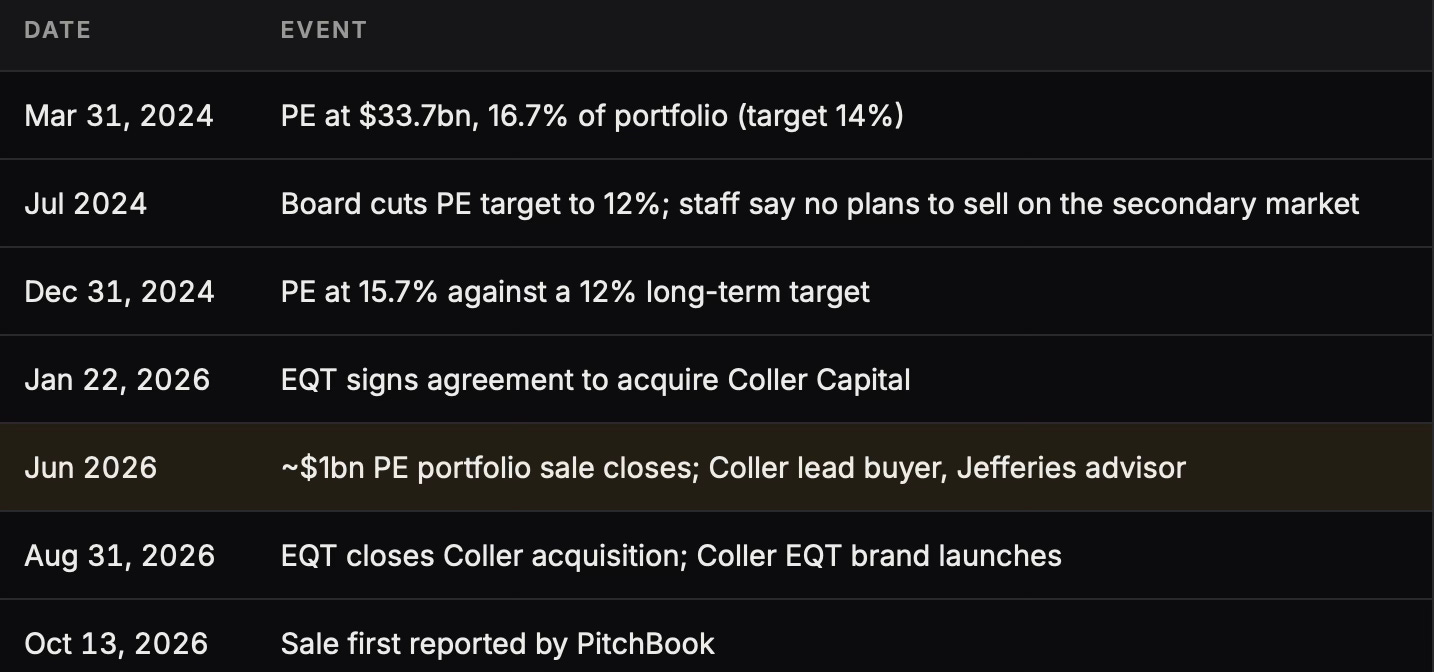
Sources: Bloomberg, Dallas Morning News (2024 board meeting); Markets Group (Dec 2024 allocation); PitchBook (sale); EQT (acquisition dates).
THE DENOMINATOR, REVISITED
This is not the first time TRS has run over target. In September 2022, staff brought the board a proposal to amend the private equity maximum allocation, with the PE weight running between 18.2% and 18.9% against a 14% policy target. In our reading, the cause has shifted since then. In 2022, falling public markets shrank the denominator. Now public markets have recovered, but slow exits keep private equity NAVs elevated, and the overweight persists anyway.
TRS is not alone
Large public allocators that once treated secondary sales as a last resort now use them to manage allocations. The TRS deal is smaller than the two most recent public pension precedents, but it fits the same pattern:
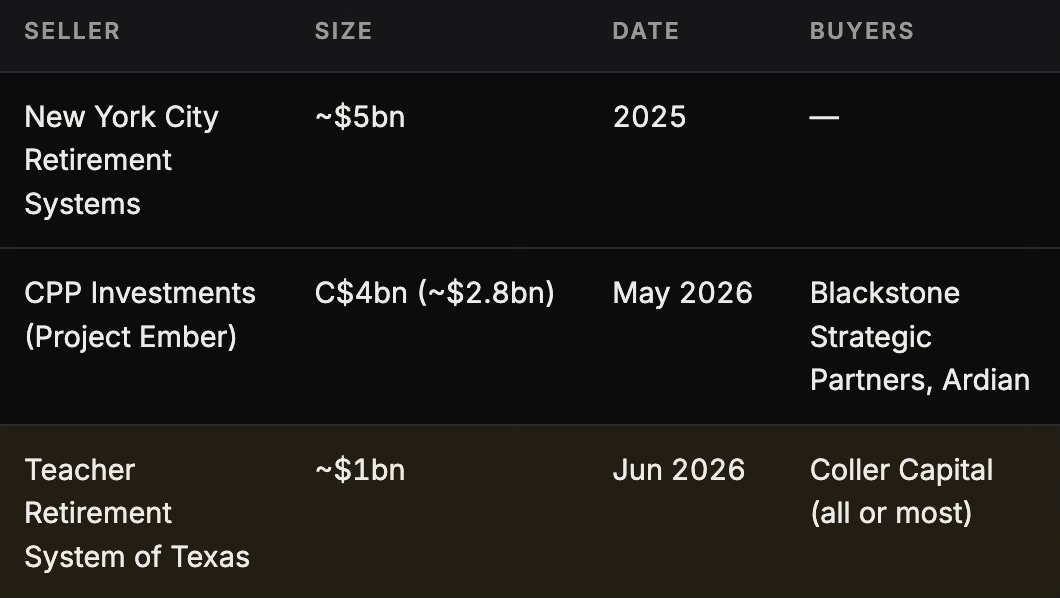
Sources: PitchBook; CPP Investments.
Volume across the LP-led market supports the same reading. Evercore puts H1 2026 LP-led volume at $56bn, up 4% year over year.