


Every fundraising report this year has told some version of the same story: capital in secondaries is consolidating around a handful of incumbents big enough to offer LPs scale, differentiated deal access, and decades of relationship capital. PitchBook’s Q1 2026 Global Private Market Fundraising Report says it plainly, success is increasingly concentrated among managers who already have all three.
Then a three-year-old firm nobody outside the LP-relationship circuit had heard of closed the largest debut secondaries fund ever raised.
The number
Clipway, the London-based secondaries shop founded in 2023, has closed Clipway Secondary Fund I at $6.4 billion, 60% above its original $4 billion target, and enough to surpass Apollo’s $5.4 billion S3 Equity and Hybrid Solutions Fund I (closed May 2025) as the largest first-time secondaries vehicle on record. That’s not “large for a debut fund.” That’s large, full stop, for any secondaries vehicle raised by anyone.
The capital came from 186 LPs: sovereign wealth funds, pension plans, insurers, endowments, foundations and family offices, spread genuinely globally: Europe supplied 44%, North and Latin America 21%, the Middle East 18%, Asia 17%. Strategic backers include Mubadala Investment Company, Carmignac, and General Atlantic, the kind of anchor names that don’t show up on a debut fund by accident. Clipway’s own release goes further on the Carmignac relationship specifically, saying the firm has played “a key role in shaping and advancing Carmignac’s private equity platform”, a secondaries manager acting as architecture partner to one of its own strategic LPs, not just a capital recipient. Sovereign capital and established managers underwriting a three-year-old platform is itself a data point: it means the LP diligence process treated Clipway less like a startup bet and more like a known quantity. Clipway is now calling itself, in its own words, “the world’s largest independent, dedicated, tech-enabled secondaries firm”, a claim about category positioning, not AUM, but a bold one for a firm three years old.
Pedigree did the heavy lifting the fund needed
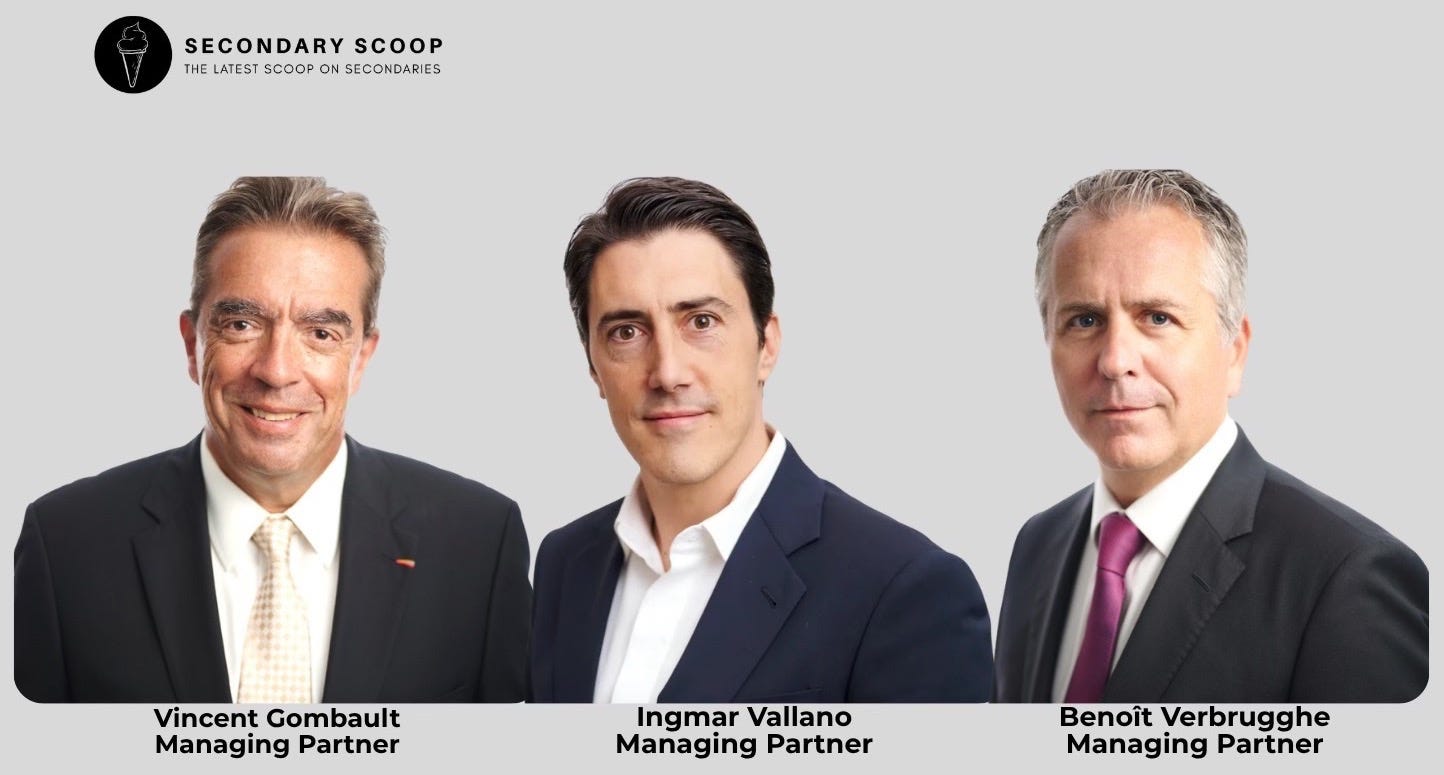
That “known quantity” framing traces straight back to where the founders came from. Vincent Gombault co-founded Ardian and ran its funds-of-funds and private debt business until December 2020. Ingmar Vallano was senior managing director for Ardian’s fund-of-funds and co-investment activity until 2021. Benoît Verbrugghe led Ardian USA and sat on its executive committee. Between them, that’s a combined multi-decade track record inside the platform widely regarded as the largest secondaries manager in the world, which is exactly the kind of resume that lets a brand-new firm skip the “prove yourselves on a small Fund I first” step that most new entrants don’t get to skip.
In other words: Clipway isn’t really a counter-example to the scale-and-pedigree consolidation thesis. It’s arguably a confirmation of it, wearing a different logo. LPs weren’t betting on an unproven team; they were betting on an Ardian-shaped team operating outside Ardian, unencumbered by a larger platform’s overhead and able to move faster.
Worth noting too: this isn’t a three-person shop trading on old business cards. Clipway’s own release puts headcount at 62 professionals across six offices, including 18 dedicated to data science and technology, and equity is deliberately spread across a wider partner group (Inigo Weston, Joshua Manasseh, Jonathan Hillgarth-Williams, Harry Vander Elst, David Enriquez and Adaleine Yong join the three Managing Partners), with no single individual holding more than 10% of the firm. That’s a governance choice as much as a cultural one: it signals the firm was built to outlast its three founders, not just monetize their Rolodexes. One regulatory detail that didn’t make the trade press: Clipway Limited operates as an appointed representative of Langham Hall Fund Management LLP rather than holding its own direct FCA authorization, a common, faster route to market for a new manager, but a reminder that “world’s largest independent secondaries firm” is still, in regulatory terms, a young platform riding on a host’s permissions.
The part that actually is new: TESS
Where Clipway does break from the playbook is technology. The firm has built TESS, a proprietary system that screens and underwrites deals against a database covering more than 38,500 private companies and 3,400 private equity funds before a human ever looks at the opportunity. The scale of the filtering is the real headline number here, and it’s not in the PitchBook piece: Clipway says it has processed more than $267 billion of opportunities through TESS to select the roughly $6 billion it has actually deployed, a hit rate of just over 2%. That’s the clearest evidence yet that TESS is functioning as a genuine screening filter rather than a marketing layer bolted onto a conventional sourcing team; you don’t publish a 2% conversion rate unless the funnel above it is real.
According to the firm, two-thirds of the $6 billion-plus in transaction volume it has deployed so far was sourced proprietarily and off-market, a genuinely high proportion for a strategy (diversified LP-led secondaries in North American and Western European buyout funds) where off-market sourcing has traditionally been a function of relationship depth built up over years, not software. Clipway has also extended TESS outward: strategic partners get access to the system to monitor and analyze their own private equity portfolios, turning what could have been a purely internal underwriting tool into a client-facing product in its own right.
That’s the actual thesis, in Vallano’s own words to PitchBook: “We are quite heavily focused on LP-led secondaries. And the idea of setting up a new company was really to focus on the use of technology to help approach the market, same old-fashioned strategy, but really approaching it in a more modern way.” Same strategy Ardian runs at scale; different infrastructure for finding and pricing the deals.
This matters beyond one fund
Clipway has already put the capital to work, more than $6 billion deployed across 1,403 underlying companies in 177 funds, a breadth of diversification that would take most new managers years to assemble manually, sourced from a $267 billion funnel most managers couldn’t process at all. If TESS is doing real underwriting work rather than just marketing gloss on top of a normal sourcing team, it’s a template worth watching: pedigree gets you in the door with LPs, but a sourcing system that can screen tens of thousands of companies before a human touches the file is what lets a three-year-old firm compete on deal flow against platforms with decades more history. Clipway frames its edge explicitly in discount terms too, the firm says its selectivity is designed “to generate alpha within the LP-led secondary market by acquiring high-quality private equity exposure at attractive discounts to market pricing,” with a deliberate tilt toward developed-market, mid-market companies.
The honest read for the rest of the market: this isn’t proof that scale doesn’t matter in secondaries. It’s proof that the fastest way to build scale from zero is to import it, in the form of a founding team’s relationships and a widely-shared partnership structure built to retain them, and then automate the one piece (sourcing breadth) that used to require headcount and time. Clipway itself is betting the timing works in its favor, pointing to “significant growth in the global secondaries market, driven by the continued expansion of private markets, slower exit activity and increasing demand for LP liquidity” as the backdrop for the raise. Worth watching whether Fund II, whenever it launches, tries to prove the tech was the real driver by targeting a number Ardian-pedigree alone couldn’t explain, and whether that $267 billion sourcing funnel keeps scaling as fast as the fund did.