


Last week, IPEM Global was held in Paris, and if you weren't among the 6,000 delegates, we made sure to take detailed notes on the Secondaries Summit for you! The summit's opening slot was billed as scene-setting, and for the first few minutes, it played that role in the most literal sense: a wall of numbers from a market that, on paper, has never had a stronger run. The speaker, Iyobosa Adeghe, Partner at Coller EQT with 14 years in the industry, opened with figures that matched Evercore's own published research almost line for line, noting that secondaries volume grew roughly 40% in 2025 and that the momentum carried straight into this year. Deal teams were tracking $15–20 billion of potential opportunity moving through the market each month across January, February, and March, before easing off somewhat heading into the second quarter.
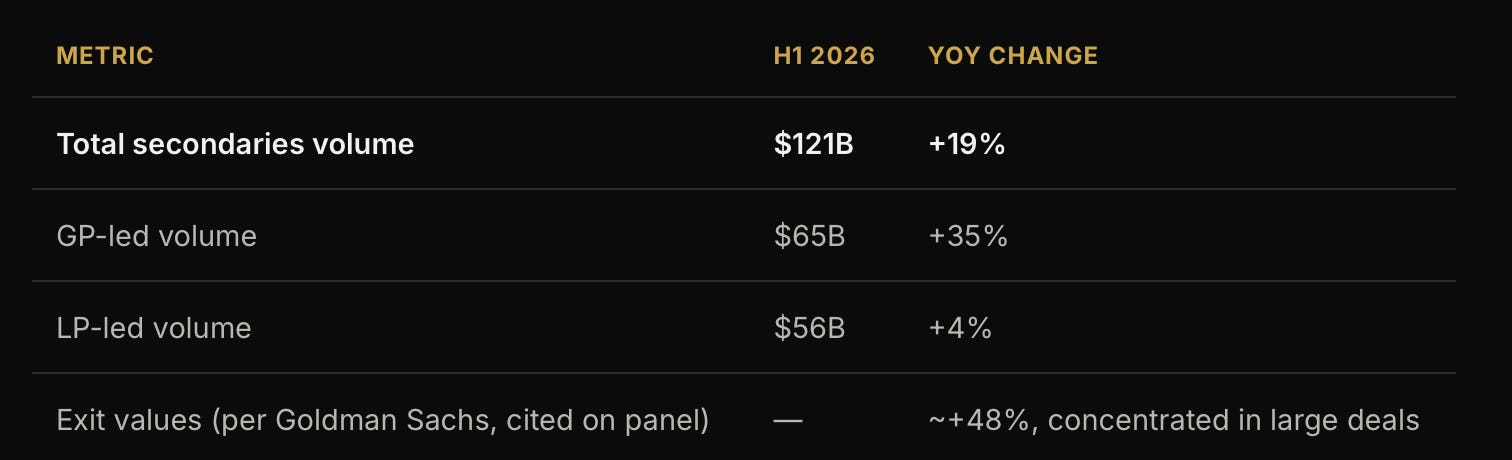
The headline number for the half: roughly $120 billion of secondaries volume, up 19% year-over-year and the strongest first half the market has recorded.
A resilient market that hides its own concentration
The more interesting part of the session wasn’t the growth story, it was the case for treating that growth story with some suspicion. The speaker pointed to the resiliency of public markets as a genuine tailwind: the S&P 500 up roughly 12% year-to-date, the MSCI World up 12–13%. But underneath that resilience sits a concentration problem that anyone marking a private portfolio against public comparables needs to reckon with. A single name, Nvidia, was cited as contributing more than 20% of the index’s return, which means that the benchmarks investors compare their portfolios against “may not, or probably not,” reflect the specific businesses they actually hold.
“Whatever the world’s thrown at this industry... the market still grew. So we think we’re in the right place, in a sense.”
WHY THIS MATTERS FOR LPS AND BUYERS
If public indices are being carried by a handful of AI-exposed names, then any valuation exercise that leans on public comps as a sanity check risks importing that same concentration into private portfolio marks. The speaker’s practical takeaway was to get granular: assess specific businesses and specific risks rather than assume a rising index validates a rising NAV.
That granularity point extended to rates and financing. The environment was described as comparatively stable in the US, with more open debate in Europe over the path of rates, and by extension, over financing costs and leverage assumptions baked into secondaries pricing. Discounts persist in this market not simply because of a single macro variable but because there is, as there almost always is, some source of real uncertainty for buyers to price in.
Exits: better on paper, narrower in practice
On the exit environment, arguably the single biggest swing factor for DPI-starved LPs, the message was cautiously constructive but heavily qualified. A year ago, the industry expected to be working through a backlog of unexited companies as both M&A and capital markets activity picked back up. That has happened only partially. Citing Goldman Sachs research, the speaker noted exit values are up close to 48% versus the first half of last year, but that growth is “highly concentrated in very large deals,” meaning the improvement is real for sponsors with exposure to headline-scale exits and far less visible for everyone else.
The broader point tied back to the industry’s chronic distribution problem. Sponsors want DPI; LPs want distributions; and a market that’s technically delivering more exit value doesn’t help much if that value is locked inside a small number of transactions. As the speaker put it, the lesson of the last year has been to keep challenging your own assumptions on exit timing, because the market keeps producing surprises, and not always the kind that show up in the aggregate statistics.
Regarding 2027, expectation is still challenging, distribution will be hard. Which makes the point for a real need to communicate and educate investors on what is being done in this market.
The role of AI in all this? A tool for fair value. Owners of assets will know better the value of their assets, which is great for the transparency we need and that was mentioned along the summit, and we will bring it to you on the upcoming articles.