


When Anthropic published its transfer restriction policy in February 2026 — and updated it yesterday — the message to private markets was unambiguous: any sale or transfer of its shares without board approval is void and will not be recognized on its books. The policy covers direct sales, SPVs, forward contracts, and tokenized securities. For secondary market practitioners, it raised an immediate question: had they seen this before?
This is not a new story.
The tension between high-demand private companies and the secondary markets that trade their shares is as old as the modern secondary market itself. What’s new is the legal weapon — the word “void” instead of “voidable” under Delaware corporate law — and the coordinated escalation of two trillion-dollar AI companies doing it simultaneously. What’s not new is the underlying dynamic: when a private company becomes desirable enough, it eventually tries to take back control of its own equity.
Act I: Facebook and the 500-Shareholder Problem (2010–2012)
Facebook did not just experience the first modern secondary market crackdown. Facebook helped create the modern private-company secondary market boom — and later spent years trying to contain it.
Platforms like SecondMarket and SharesPost grew rapidly on the back of demand for Facebook employee shares. By 2010–2011, Facebook had become the dominant name in private secondary trading, with Facebook transactions accounting for roughly 39% of completed transactions on SecondMarket in 2010.
Demand became so intense that Facebook shares traded in private markets at prices ranging from the low-$30s to low-$40s per share before the IPO. SharesPost auctions reportedly cleared around $34 per share in early 2012, while some secondary trades reached as high as $44 before Facebook’s IPO priced at $38.
But Facebook had a structural problem: under a 1964 SEC rule, private companies with more than 500 shareholders were required to comply with the same financial disclosure requirements as public companies. And the secondary market was pushing Facebook dangerously close to that threshold.
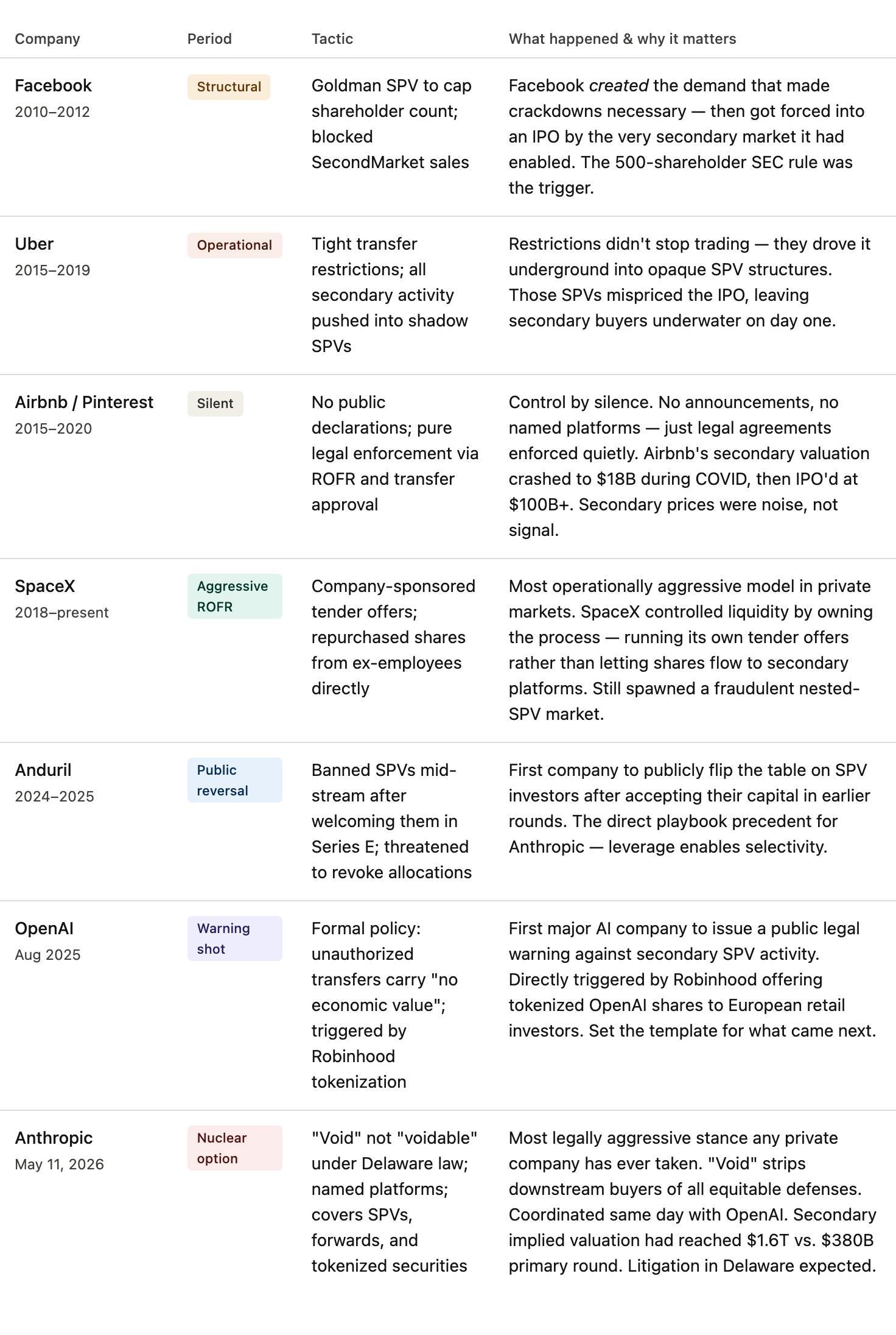
In January 2011, Facebook responded with a move that looked like a funding round but was partly a defensive maneuver: a $500 million Goldman Sachs deal designed in part to stop employees from selling shares on secondary exchanges and to keep the total shareholder count below 500. Goldman had to restrict the offering to US investors after SEC scrutiny raised concerns about whether a wider offering would trigger disclosure requirements.
It didn’t work. By the time Facebook went public in May 2012, the company had been effectively forced into the IPO by a shareholder count it could no longer control — a direct consequence of years of unmanaged secondary activity.
The lesson from Facebook was heard loudly in Silicon Valley: the next generation of high-growth companies — Airbnb, Pinterest, Uber — made it a near-universal policy to block secondary transactions. That posture gave rise to a new generation of workarounds, most notably forward contracts traded on platforms like Forge, where employees could lock in a price without technically transferring shares in a way the company could detect.
Act II: Uber’s Famously Tight Grip (2015–2019)
Uber maintained some of the most aggressive transfer restrictions in Silicon Valley throughout its years as a private company — and it still couldn’t stop a secondary market from forming around its shares.
Because Uber’s direct share transfers were so heavily restricted, secondary market activity shifted almost entirely to SPVs: pooled vehicles that claimed to hold Uber equity and sold LP interests to investors who wanted exposure. By 2017, market observers noted that virtually all Uber secondary trades were transfers of interests in SPVs rather than actual share transfers, and that the company’s tight controls meant any data points from secondary markets should be “taken with a grain of salt.”
The problem with SPV-based workarounds was that they allowed a shadow price to develop for Uber equity that was disconnected from any authorized transaction. When Uber IPO’d in May 2019 at $45 per share — below the $48 to $55 range it had originally targeted — investors who had paid secondary market premiums in SPVs were already underwater before the first day of trading.
Uber’s story contains an early version of the pricing risk that Anthropic is now trying to manage: when secondary markets quote your company at valuations you don’t control, those valuations become the market’s expectation. When reality diverges, it’s your IPO that suffers.
Act III: The Airbnb/Pinterest Generation — Control by Silence (2015–2020)
Following the Facebook precedent, the next cohort of consumer tech giants — Airbnb, Pinterest, Snap, Lyft — took a more systematic approach: they didn’t make public declarations about secondary restrictions. They simply blocked transfers at the source, enforced right of first refusal aggressively, and let their legal agreements do the work quietly.
Airbnb was particularly disciplined. The company went through a brutal COVID-driven valuation reset in 2020 — from a last primary round at $31 billion down to a secondary market low near $18 billion — before bouncing back and ultimately IPO-ing in December 2020 at $68 per share, valuing the company at over $100 billion on its first day of trading. The gap between the private market’s panic pricing and the actual IPO outcome was one of the most dramatic mispricing episodes in secondary market history.
The Airbnb episode reinforced a key lesson: secondary market prices are not accurate signals. They are demand signals. A company trading down on Forge does not mean the company is worth less. It means sellers are more motivated than buyers at that moment. And a company trading up at multiples of its last primary round does not mean it’s worth that much — it means the imbalance between supply and demand on secondary platforms has overwhelmed price discovery.
Act IV: SpaceX — The Operationally Aggressive Model (2018–Present)
SpaceX represents the most comprehensive approach to secondary market control prior to Anthropic’s legal escalation — not through public declarations, but through systematic operational enforcement.
SpaceX has maintained extraordinarily tight control over its cap table for years. The company exercises aggressive right of first refusal on virtually all share transfers. It has conducted multiple company-sponsored tender offers specifically designed to provide employee liquidity on the company’s own terms — preventing shares from flowing to the open secondary market in the first place. In multiple documented cases, SpaceX repurchased shares from former employees rather than allow them to sell to outside buyers.
The effect is a cap table that reflects intentional choices rather than secondary market drift. SpaceX knows exactly who its shareholders are. That cap table control has become a strategic asset as the company approaches its own IPO — now expected in 2026 as part of the combined SpaceX/xAI entity, potentially at a valuation exceeding $1.5 trillion.
The downside of SpaceX’s tight controls is that they created the same shadow SPV market that plagued Uber. Because direct transfers are functionally impossible, investors who want SpaceX exposure have been pushed into increasingly opaque nested SPV structures — SPVs that hold interests in other SPVs that may or may not hold actual SpaceX equity at the base of the stack. The fraud risk in this market is real, and it is one of the most underreported stories in private markets today.
Act V: OpenAI’s Warning Shot (August 2025)
Before Anthropic’s formal legal escalation, OpenAI fired the first public warning shot in August 2025. The company issued a policy stating that unauthorized equity transfers would be voided and “carry no economic value” to buyers — a direct shot across the bow of secondary platforms that had been offering OpenAI exposure.
The timing was not coincidental. Robinhood had just announced it would allow European investors to trade tokenized versions of US private company shares, with OpenAI as one of the flagship offerings. OpenAI’s response was swift and unambiguous: that structure violated its transfer restrictions.
The tokenization of private equity had crossed a line. By mid-2025, platforms like PreStocks and Ventuals were offering retail investors synthetic exposure to OpenAI and Anthropic at implied valuations that bore no relationship to primary round prices. OpenAI’s August 2025 statement was the first clear signal that the AI giants were going to fight back — not just through operational enforcement, but through public legal posture.
Act VI: Anthropic Draws the Line — The "Void" Declaration (February–May 2026)
What happened with Anthropic is qualitatively different from everything that came before it. Not in intent — controlling the cap table before an IPO is a story as old as Goldman’s Facebook SPV in 2011 — but in legal precision.
Previous crackdowns used the word “voidable.” Anthropic used “void.”
Under Delaware corporate law, that distinction is enormous. A voidable transfer can potentially be ratified, defended in court, or remedied through negotiation. A void transfer never legally existed. Sellers can retain both the cash and the shares. Entire chains of downstream secondary transactions can be wiped from the cap table simultaneously. Buyers have no equitable defense.
Anthropic combined this legal posture with a named list of unauthorized platforms — Forge, Hiive, Sydecar, Upmarket, and others — and explicitly extended the void designation to tokenized securities and forward contracts. That last point is critical: it closes the loop on every known workaround that secondary markets had developed since the Facebook era.
Simultaneously, OpenAI formalized its own policy with nearly identical language. Two companies with a combined secondary market valuation approaching $2 trillion issued coordinated legal declarations on the same day. The secondary market for AI equity has not been the same since.
What This Means for the Secondary Market Going Forward
The Anthropic/OpenAI dual declaration represents the end of the informal era of pre-IPO secondary trading in AI. Here is what secondary market professionals need to watch:
The authorized custody model becomes the only viable path. The tokenized pre-IPO market may have to rebuild entirely around structures that are explicitly sanctioned by the issuer. Synthetic exposure through SPVs — the mechanism that democratized access to private markets for a decade — may be legally untenable for the most sought-after names.
LP portfolio exposure needs legal audit. Any LP with indirect Anthropic or OpenAI exposure through an SPV, a feeder fund, or a tokenized instrument should understand the legal structure of that holding urgently, before Delaware courts begin ruling on enforceability.
The access gap widens. For the vast majority of private companies — those without Anthropic’s leverage, demand, or legal firepower — SPVs remain an essential capital formation tool. The crackdown is not a signal that SPVs are dying. It is a signal that they are reserved for companies that don’t have the power to say no.
The IPO window is the key variable. Every historical crackdown has coincided with pre-IPO preparation. Facebook did it. Anduril did it. Now Anthropic and OpenAI are doing it. Once these companies are public, the enforcement mechanism becomes irrelevant. The window for legal risk is roughly now through IPO — likely Q4 2026.
Other trillion-dollar private companies are watching. The question is whether this is an Anthropic/OpenAI-specific move or the beginning of a broader industry standard. If SpaceX follows with a formal “void” declaration before its IPO, the template becomes permanent.
The Bottom Line
The company always wins — eventually. What changes with each cycle is how long it takes, how legally aggressive the tool, and how much collateral damage is left on the secondary market when the dust settles.
For secondary market practitioners, the lesson of the past 15 years is not that these markets are illegitimate. It is that they operate in the shadow of issuer consent, and that consent can be withdrawn — retroactively — when the issuer has enough leverage to do so.
The Anthropic move is the most aggressive version of a story that began with Mark Zuckerberg trying to keep Facebook’s shareholder count below 500. Same instinct. Fifteen years of legal innovation. Dramatically higher stakes.
Secondary Scoop covers the secondary market for venture capital and private equity. For GPs, LPs, and anyone who needs to understand how private market liquidity actually works.