


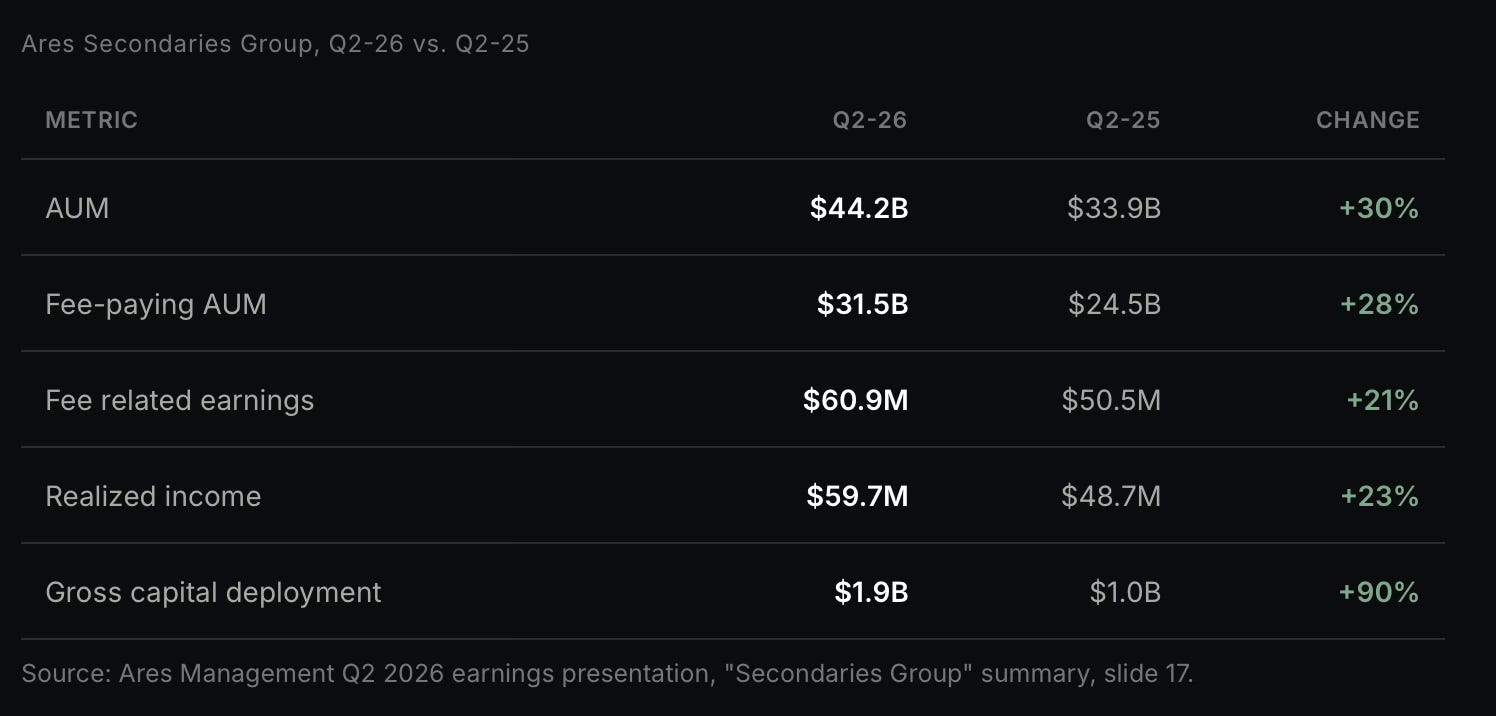
On July 31, Ares Management reported another record fundraising quarter, $36.4 billion raised, the largest in the firm’s history, and a Secondaries Group that grew assets under management 30% year-over-year to $44.2 billion. By almost every measure on the earnings call, the secondaries platform looked like one of the firm’s strongest stories.
Except for one line. On the investment performance summary that opens Ares’ own earnings deck, private equity secondaries showed a gross return of −5.3% for the quarter and −1.7% over the trailing twelve months, the only strategy on the entire page, across credit, real assets, secondaries and private equity, to post a negative LTM number.
That is an odd thing to see attached to a firm that spent the rest of the call talking about secondaries momentum. It is also, per Ares’ own explanation on the call, largely an artifact of how the number is built, not a read on how the business is actually performing today.
The number investors see first
Ares discloses secondaries performance two ways in its quarterly materials. The first is a single-line composite on the “Investment Performance Highlights” slide, the kind of summary an analyst skims in the first thirty seconds of opening the deck. For Q2-26, that slide showed:
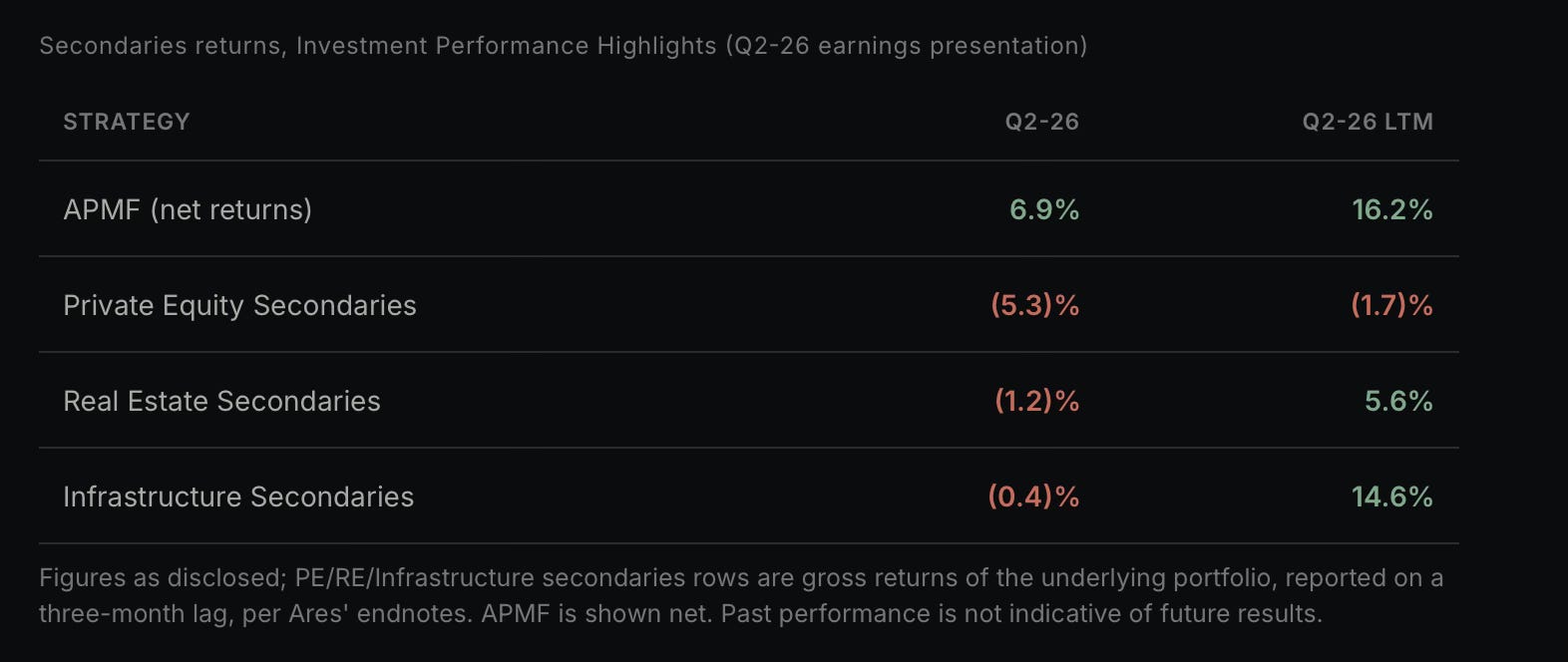
Buried further into the deck, in an endnote on slide 42, not the summary table, Ares clarifies that the private equity secondaries line is a composite of two funds: Landmark Equity Partners XVI and Landmark Equity Partners XVII. On a net basis, that composite returned −3.7% for the quarter and −1.3% over the trailing year. Better than the gross figure, but still negative.
It took a direct analyst question to get the real explanation.
What Arougheti actually said
On the call, an analyst asked CEO Michael Arougheti directly why private equity secondaries returns were negative for the quarter when APMF, Ares’ publicly disclosed perpetual secondaries vehicle, was performing well and secondary market activity was described as robust.
“Fund 17, which was the first fund that we deployed under Ares, the performance there is pretty strong. Since inception, returns about 26% gross and net with about 17. Fund 16, which was the last fund, which is a much older vintage but a much larger fund, can have an outsized impact on the composite as we report. That’s basically what’s happening there. That older vintage fund, just given its size, moved down. But if you look at all the active in the ground funds, Fund 17, APMF, we’re actually continuing to see strong, strong returns.”
Michael Arougheti, CEO, Ares Management — Q2 2026 earnings call, July 31, 2026
Translated into fund names using Ares’ own glossary: “Fund 16” is Landmark Equity Partners XVI (LEP XVI), a 2016-vintage fund with $3.97 billion in AUM that Ares still discloses in its standard performance tables. “Fund 17” is Landmark Equity Partners XVII (LEP XVII), the fund Arougheti describes as the first one Ares deployed following its 2021 acquisition of Landmark Partners, and the one he credits with the ~26% gross / ~17% net IRR since inception.
WHY THE NUMBERS DIVERGE
A composite return blends the results of every fund in a strategy, typically weighted by size. When a large, older fund is winding down its remaining marks while a smaller, newer fund is compounding early gains, the composite can go negative even while every dollar of fresh capital is being invested into a strategy performing well.
Arougheti’s own framing on the call reinforces the point: LP-led secondary purchases tend to show a return bump on entry as the buyer captures a NAV discount, while GP-led transactions “tend to see more consistency but less volatility.” A composite that mixes a legacy LP-led fund nearing the end of its life with a newer fund built more around GP-led activity will not move in a straight line, and reading the blended number without the components can lead an LP to draw exactly the wrong conclusion about current underwriting quality.
What’s actually disclosed, and what isn’t
Here is where it’s worth being precise about what LPs can verify versus what they have to take on faith. Ares’ supplemental fund performance table (slide 32 of the earnings deck) discloses hard numbers for LEP XV and LEP XVI, plus APMF. LEP XVII, “Fund 17,” the fund driving Arougheti’s bullish framing, does not appear in that table at all. Its 26% gross / ~17% net IRR exists only as a verbal figure from the call, not as a line item in Ares’ standardized disclosure.
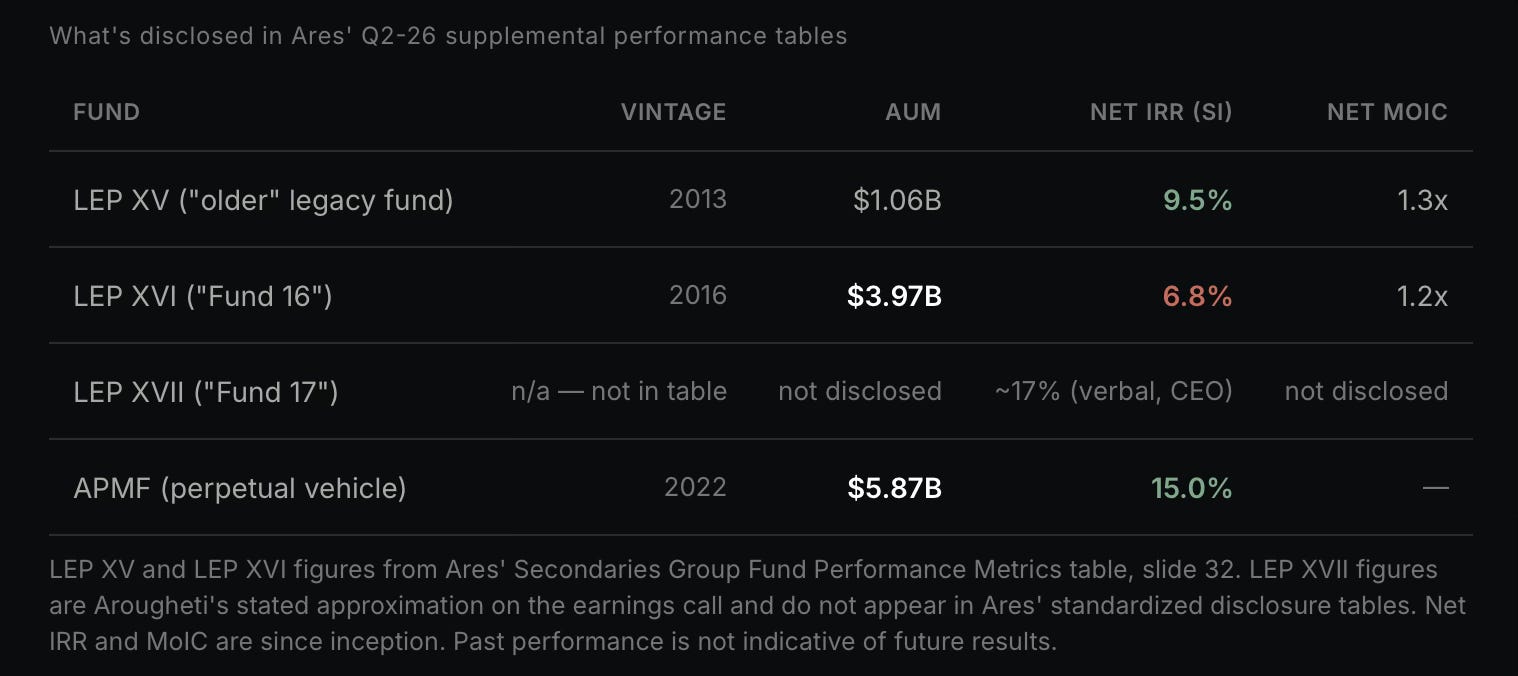
That’s not necessarily a red flag, Ares only reports individual fund lines for what it calls “significant funds,” those contributing at least 1% of total management fees or FPAUM for two consecutive quarters, and a fund as new as LEP XVII may simply not have crossed that threshold yet. But it does mean the single strongest data point in Ares’ explanation for a negative composite is, for now, unverified against the company’s own standardized reporting. LPs relying on Ares’ disclosure documents alone would see the drag from Fund 16 and the strength of APMF — not the Fund 17 number that, on the call, did the most work to reframe the story.
The broader point Arougheti made
Worthington’s follow-up question was more structural: are secondaries returns lagging primary private equity by more than usual this cycle? Arougheti’s answer is worth reading in full, because it captures something Secondary Scoop has argued from the other direction for a while — that secondaries performance needs to be read on its own terms, not benchmarked against primary buyout returns.
“I think if you were to look at the historical return data, the secondaries returns will generally be lower, but they also tend to be range bound. If you were to look at PE secondary returns, first quartile to fourth quartile, the dispersion of returns is much tighter than you see in the primary market... You’re going to get a generally lower return, but a much lower volatility of return versus the primary market.”
Michael Arougheti, CEO, Ares Management — Q2 2026 earnings call, July 31, 2026
He also flagged that this dynamic may shift as the market structurally moves toward GP-led transactions and continuation vehicles, which behave differently from legacy LP-led portfolio purchases. That’s a claim worth watching rather than accepting outright — Ares has an obvious incentive to frame secondaries as a durable, lower-volatility allocation given how central the strategy now is to its wealth channel distribution (APMF alone drove the bulk of the segment’s 141% year-over-year growth in fee-related performance revenue this quarter). But directionally, it lines up with what the broader secondaries market has been signaling: GP-led volume has been the primary growth engine industry-wide, and the return profile of a continuation vehicle is mechanically different from a blind-pool LP stake purchased a decade ago.
The segment, in context
Strip out the composite noise and the underlying Secondaries Group numbers for the quarter were straightforwardly strong: AUM up 30% year-over-year to $44.2 billion, fee-paying AUM up 28% to $31.5 billion, fee related earnings up 21% to $60.9 million, and realized income up 23% to $59.7 million. The segment deployed $1.9 billion in the quarter — split roughly $0.8 billion in PE secondaries, $0.4 billion in real estate secondaries and $0.4 billion in credit secondaries — and this quarter’s deck breaks out credit secondaries as its own AUM line for the first time we’ve seen from Ares, at $5.0 billion, alongside PE secondaries ($24.2B), real estate secondaries ($7.8B) and infrastructure secondaries ($7.2B).
On the real estate side, Arougheti flagged "good momentum" in what he called Ares' "global structured solution strategy," which raised over $500 million in the quarter, and the firm expects an initial close on its next dedicated real estate secondaries fund in the second half of 2026, with fundraising described as running ahead of the pace of the prior vintage at the same point. Neither of those items came up as a Q&A topic, but they round out a picture of a platform expanding across every secondaries sub-strategy — PE, real estate, infrastructure and now credit — even in the same quarter its headline PE return went negative.