


Marsh confirmed today that it has completed its acquisition of AltamarCAM, the Madrid-headquartered private markets manager. The deal was first announced on March 19 through Mercer, Marsh’s investments business. It brings AltamarCAM’s roughly 280 employees in Madrid, Munich, Barcelona, Cologne, London, New York and Santiago de Chile onto Marsh’s payroll. AltamarCAM will drop its own name and adopt the Marsh brand. Terms were not disclosed in March or today.
The headline number is Marsh’s private markets AUM, which rises to $75bn. For secondaries, the real point is who the buyer is. Marsh is not a GP like EQT or a bank-owned asset manager like Goldman. It is the parent of one of the world’s largest investment consultants. Read alongside WTW’s acquisition of FlowStone Partners, which closed on April 1, both of the big consultant-to-OCIO franchises have now bought secondaries capability instead of building it.

What Marsh actually bought in secondaries
AltamarCAM is a multi-strategy house, not a secondaries pure-play. That matters for reading the numbers. The €20bn covers primaries, co-investments, real assets, private credit, venture (including the Galdana Ventures family) and a large bespoke SMA business. Neither AltamarCAM nor Marsh has disclosed how much of it is secondaries. The most recent public breakdown we found is a 2023 investor presentation that put PE secondaries at 13% of the portfolio. That figure is three years old and predates ACP Secondaries 5.
The secondaries franchise is nonetheless real, and it has been growing. Secondaries Investor has called AltamarCAM Spain’s biggest secondaries firm by fundraising. Its flagship series has gone from just over €1bn to roughly €1.6bn in a single vintage. Each of the last two funds closed above target.
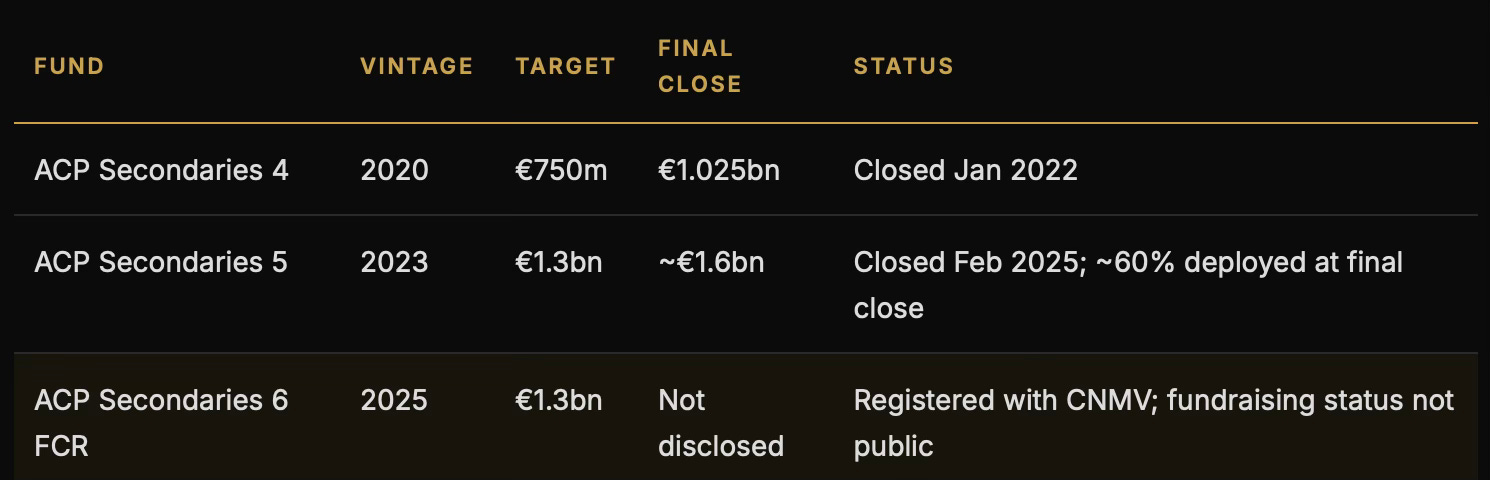
Sources: AltamarCAM press releases (Jan 2022, Feb 2025); Secondaries Investor; capital-riesgo.es (ACP S6 registration). Earlier vehicles in the series (ACP S1–S3, 2010–2017) are smaller and not shown.
The strategy is a mid-market, LP-portfolio-heavy approach, with ACP Secondaries 6 mainly buying positions in buyout, growth and venture funds. ACP S5 drew LPs from 16 countries, and German-language coverage of the close said 40% of its investors were new to AltamarCAM. The firm credited part of that wider international LP reach to Permira. That is the franchise Marsh now owns, and ACP Secondaries 6 is the first flagship that will be marketed under Marsh’s name rather than AltamarCAM’s.
DON’T STACK THE AUM FIGURES
Four different numbers are circulating, and they measure different things. $692bn is Mercer’s total global AUM across all asset classes (Dec 31, 2025). $75bn is Marsh’s combined private markets AUM after the deal (Jun 30, 2026). Marsh notes that this figure includes committed but uncalled capital and may overlap with other client assets it manages. €20bn is AltamarCAM’s total AUM across all strategies. AltamarCAM’s secondaries AUM is undisclosed. Marsh has not become a $75bn secondaries buyer, and it has not become a top-ten secondaries platform.
Two consultants, one playbook
The secondaries consolidation wave of 2026 has mostly been framed as GPs buying specialists. EQT paid $3.2bn for Coller Capital, the largest secondaries manager acquisition on record, and closed in September. Natixis affiliate Flexstone completed its purchase of Glouston Capital Partners the next day. Those deals follow the platform-versus-specialist logic we have tracked all year. Buyout and multi-strategy GPs want secondaries as a product line, as a source of DPI-hungry LP flow, and as an engine for their wealth channels.
The consultant deals are a different category. WTW announced FlowStone in December 2025. FlowStone was a $757m secondaries manager whose funds were open to wealth investors at a $100,000 minimum. At the time, WTW’s global head of investments, Diya Luke, described the logic as pairing FlowStone’s seasoned expertise in secondaries investing with WTW’s global scale, sourcing network and research engine.
Marsh’s deal is roughly an order of magnitude larger, but the shape is the same: an advisory and OCIO business buying a secondaries team it can wrap into discretionary mandates, bespoke accounts and evergreen products.
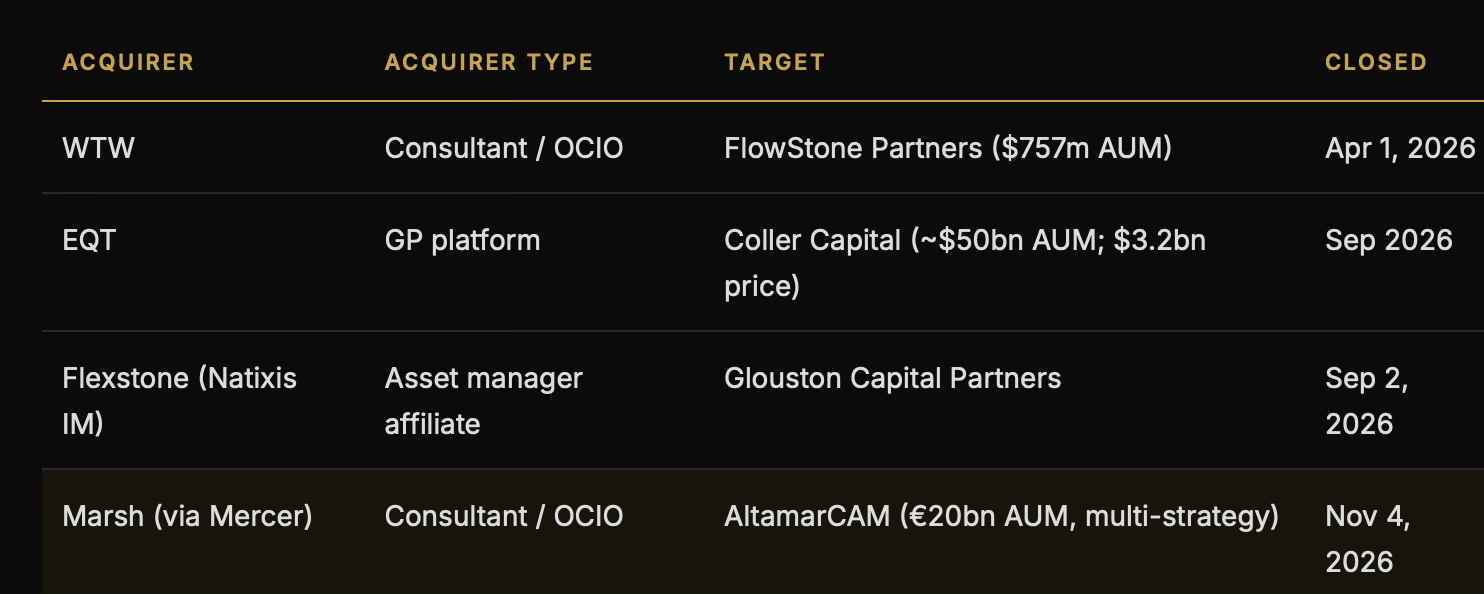
AUM figures are as reported at announcement and refer to the target firm, not the acquirer.
As private markets continue to evolve -marked by growing demand and complexity- innovation, specialist expertise, global reach and scale have never been more critical.
Michael Dempsey, Mercer’s Global President for Investments and Retirement, at announcement (March 19, 2026)
Today’s release adds a sharper line. Garvan McCarthy, Global Alternatives CIO of Marsh Investments and Retirement, said success “increasingly depends on disciplined execution and solutions that support more mature private market programs”. “Mature programs” is consultant language for clients with large legacy fund books. Those books produce the most LP-led secondary deal flow.
The question LPs will ask
When a GP buys a secondaries manager, the conflicts are familiar and, by now, well-papered. They come down to cross-platform deal allocation, and to how a buyer’s continuation vehicles get priced when the sponsor sits in the same building. A consultant owning a secondaries buyer raises a different set of questions, and LPs should press on them:
WHERE THE CONSULTANT-AS-BUYER MODEL NEEDS ANSWERS
Manager selection. When Mercer’s advisory side builds a secondaries allocation for a pension fund, how is the in-house Marsh vehicle evaluated against Ardian, Lexington, Coller EQT or a European mid-market specialist?
Information flow on LP sales. Consultants see inside client portfolios. Clients that rebalance or need liquidity are natural LP-led sellers. What walls separate portfolio-level advisory knowledge from the secondaries team’s sourcing?
Pricing and process. If a Mercer client runs an LP portfolio sale, can Marsh bid? If it can, who advises the seller?
Evergreen allocation. Secondaries are the fastest-deploying sleeve in a semi-liquid fund. Expect AltamarCAM paper to show up inside Marsh evergreen and wealth products, and expect questions about how deal flow is split between those products and the closed-end ACP series.
Neither today’s release nor the March announcement addresses these points. The same was true of WTW’s FlowStone releases. That doesn’t mean the controls don’t exist. But this is the first time a European secondaries franchise of this size has sat inside a consultant, and LP due diligence teams have no precedent to lean on.
Mid-market Europe, Madrid, and the Permira exit
The deal also matters for European mid-market secondaries supply and demand. ACP Secondaries 6 is targeting €1.3bn. With Marsh’s distribution behind it, especially in institutional markets where AltamarCAM had little reach, the next close could land well above the series’ recent trajectory. A larger AltamarCAM means more capital competing for the mid-sized LP portfolios and smaller GP-leds that European mid-market buyers depend on. In the short term, it also means a well-known Iberian and DACH brand disappears from LP pitch books at the exact moment ACP S6 is in market.
This is the ideal match for AltamarCAM.
Claudio Aguirre, AltamarCAM co-founder and executive chairman, at announcement (March 19, 2026)
For Permira, the exit is a quick round trip. Permira Growth Opportunities II took its 40% stake in 2024, and the 2024 deal was reported at the time as a possible step toward an IPO. Instead it sold to a strategic buyer about two years later. This is a GP-stakes outcome, not a secondaries transaction. Still, it adds a European data point to a pattern secondaries-adjacent investors are watching: minority stakes in mid-sized multi-strategy managers can be exited quickly through sale to a consolidator, without waiting for public markets.
Marsh says Madrid will be the hub of its international private markets platform, so the team stays where it is under new ownership. For the Spanish market, that is a better outcome than a hollowing out.