


At the Bernstein Strategic Decisions Conference in New York on May 27, State Street Chairman and CEO Ron O’Hanley described the private equity secondaries market in terms that any LP or secondaries buyer would recognize immediately — stale NAVs, forced haircuts, and a structural lack of transparency that turns price discovery into guesswork.

“Why is there so much money available in secondaries?” O’Hanley asked. “It’s because there’s just this complete lack of transparency in what you’re buying, particularly if you’re trying to buy something or sell something quickly. So, okay, that was the NAV that was struck way back then. A quarter ago, a lot’s happened. I’ll give you a 20% haircut and we’ll buy that. Oftentimes that’s what the market is.”
It was a striking encapsulation of the LP-led secondary discount dynamic from someone running the world’s second-largest asset servicer — a firm that sits on the data flows of some of the largest institutional portfolios globally. And it was not an abstract observation.
“Why is there so much money available in secondaries? It’s because there’s just this complete lack of transparency in what you’re buying.”
— RON O’HANLEY, CHAIRMAN & CEO, STATE STREET CORPORATION — BERNSTEIN CONFERENCE, MAY 27 2026
Context: State Street Already Has Skin in the Game
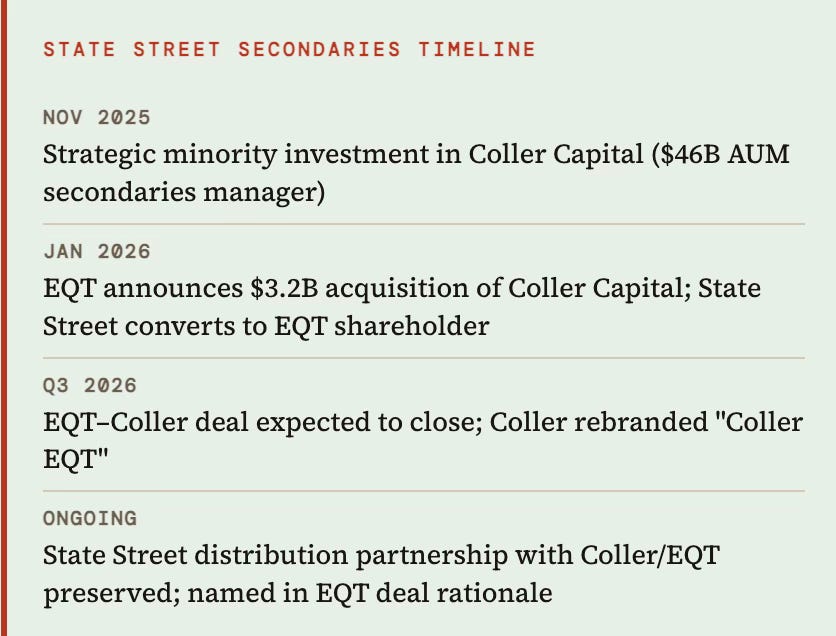
O’Hanley’s comments carry particular weight given State Street’s own recent moves in the secondaries space. In November 2025, State Street Investment Management took a strategic minority stake in Coller Capital, one of the largest dedicated secondaries managers globally with over $46 billion in assets under management across institutional and semi-liquid private wealth vehicles.
The investment was positioned explicitly around the secondaries market’s growth trajectory — over $160 billion transacted in 2024, a 16% CAGR over the prior decade, with projections pointing toward $500 billion by 2030. State Street framed the deal as access to secondaries capabilities for its institutional client base, which spans more than 60 countries.
Two months later, in January 2026, EQT announced it had agreed to acquire Coller Capital for a base consideration of $3.2 billion. State Street’s minority stake converts to EQT equity as part of the transaction, expected to close in Q3 2026. Notably, EQT’s own rationale for the deal explicitly names the State Street distribution partnership as a mechanism for scaling the secondaries platform globally — meaning the commercial relationship survives and is arguably strengthened by the Coller acquisition.
The Tokenization Thesis: O’Hanley’s Proposed Fix
O’Hanley’s diagnosis of the secondaries discount problem was paired with a structural solution: tokenization. In his framing, the NAV staleness and transparency deficit that drives haircuts in LP-led secondaries are not permanent features of the market — they are data and infrastructure problems that tokenization begins to address.
“For some assets like real estate, [tokens] make the asset much more marketable, much more tradable to help secondary markets,” he said. “Tokenization will help that.” The implication is that tokenized representations of fund interests would allow real-time or near-real-time pricing, reducing the information asymmetry that buyers currently exploit.
This is not a new thesis, but it is notable when articulated by the CEO of a firm that manages $54.5 trillion in assets under custody and administration. State Street sits at the intersection of securities processing and cash settlement — precisely the infrastructure layer where tokenization has to function for secondary market price discovery to improve. O’Hanley acknowledged the transition will be long, describing a “bridge from traditional finance to digital finance” that plays out over years, not quarters.
The Servicing Opportunity: Complexity as Revenue
On the servicing side, O’Hanley pointed to the growing back-office complexity of alternatives managers as a structural opportunity for State Street — an argument with direct secondaries implications. As LP bases diversify and secondaries transactions increase turnover on cap tables, the operational burden on fund managers compounds.
“These firms were pretty simple when they got started,” he said. “They have LPs, but each LP wants something different. So their complexity in back office has gotten greater, which is an opportunity for us.”
State Street’s Alpha platform — its front-to-back institutional servicing solution — positions the firm as the outsource provider for this operational complexity. Longer contract terms (seven years and above, versus the prior four-year standard), full middle-office outsourcing, and interoperable open architecture are the commercial mechanics of locking in that complexity revenue.
The Bigger Picture for Secondaries
What O’Hanley’s Bernstein remarks illustrate is a major institutional platform moving from passive observer of the secondaries market to active participant — on both the investment management side (via Coller/EQT) and the servicing side (via Alpha). The framing of secondaries illiquidity as a solvable infrastructure problem, rather than an intrinsic feature of private markets, is consequential: it implies continued compression of the discount advantage that buyers have historically relied on.
For LPs weighing secondary exits, the medium-term direction of travel — better data, tokenized assets, more institutional servicing infrastructure — points toward tighter pricing. For secondaries managers, that same infrastructure buildout represents both competitive pressure and distribution opportunity, as platforms like State Street’s client network become channels rather than competitors.