


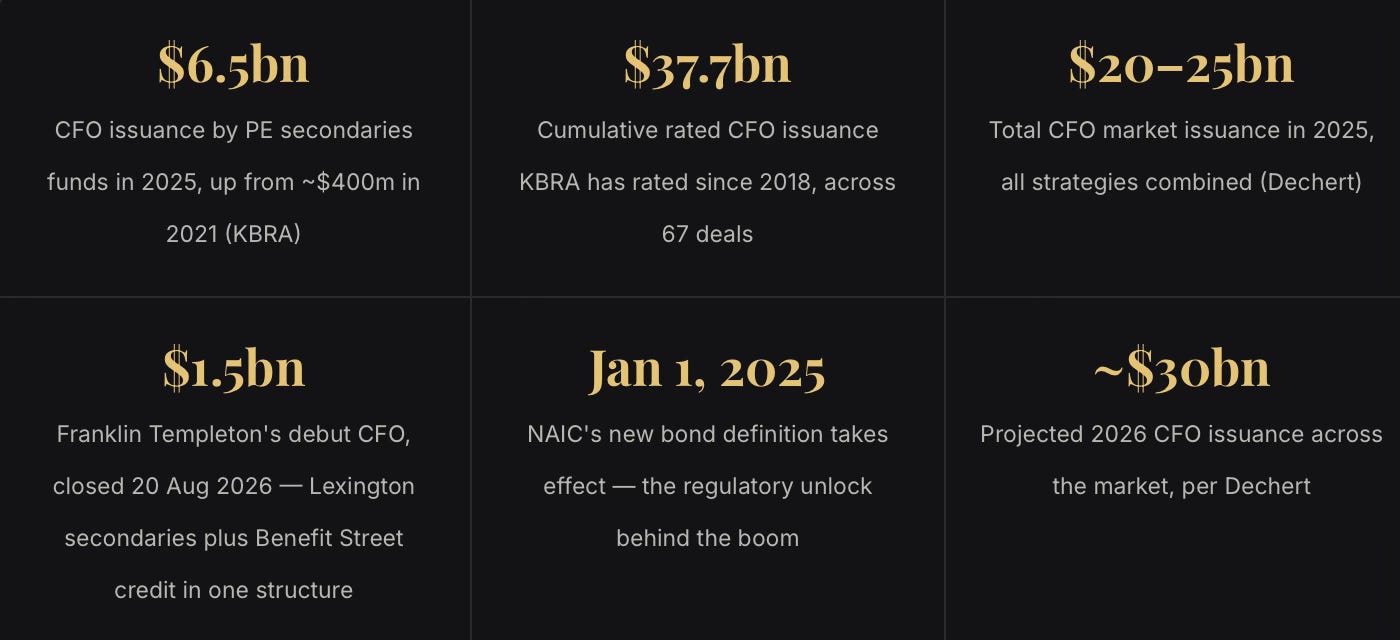
We've been wanting to write about CFOs in private equity for a while, and today's Financial Times article just gave us the push to do it. In secondaries, CFO doesn't stand for chief financial officer. It stands for collateralized fund obligation, a financing structure that barely existed five years ago and is now one of the fastest-growing sources of capital anywhere in private markets. Secondaries funds issued just over $400 million of CFO debt in 2021. By 2025, per Kroll Bond Rating Agency (KBRA), that figure was $6.5 billion. The mechanism is simple enough to explain in a paragraph and controversial enough that one structured-finance academic has already compared it to the CDOs that helped trigger 2008.
Here's what a CFO actually is, who's building them, why insurers can't get enough of them, and why they're the natural next chapter of the mainstreaming story this newsletter has been tracking all year.
What a CFO actually is
Strip away the acronym collision and the structure is closer to something most of this audience already understands intuitively than it first appears. A sponsor, often a secondaries fund manager, sometimes a GP financing its own book, sets up a special purpose vehicle. That vehicle holds a diversified pool of LP stakes in underlying private funds: buyout, venture, credit, whatever the sponsor’s portfolio is built from. The vehicle then issues several layers, or tranches, of notes against the cash flows those stakes are expected to generate over time.
The senior tranche gets paid first and, because of that seniority, can carry an investment-grade rating from KBRA, Fitch, Moody’s or S&P, sometimes as high as A. Below that sit one or more mezzanine tranches, priced for more risk and more yield. At the bottom sits an equity tranche, which absorbs the first losses if underlying funds underperform, but also keeps whatever’s left over once every other tranche has been paid. The sponsor, or a private credit fund willing to underwrite that risk, typically holds the equity piece; the senior and mezzanine notes get sold to outside investors, increasingly, insurance companies.
CFO, CLO, RNF, TRANCHED NAV LOAN: A FIELD GUIDE
CFO (collateralized fund obligation): a separate vehicle issues tranched, rated debt secured by a pool of LP stakes across multiple underlying funds. The instrument this article is about.
CLO (collateralized loan obligation): the older, much larger sibling, same tranching logic, but the underlying collateral is a pool of corporate loans, not fund interests. CFO structuring borrows heavily from CLO precedent, which is one reason rating agencies could scale up so quickly.
RNF (rated note feeder): a close cousin that raises capital through rated debt and unrated equity, then invests the proceeds into a single underlying fund rather than a diversified pool. Per Dechert’s own 2026 market commentary, the line between RNFs and CFOs is “becoming less distinct” as structures converge.
Tranched NAV loan: the structure the Financial Times centered its own recent reporting on. Here, the secondaries fund itself borrows the money, and the debt is secured directly against the fund’s own stakes in its underlying buyout funds, no separate issuing vehicle required. Economically similar to a CFO; structurally, the anchor point for the collateral is different, and trade coverage doesn’t always keep the two terms straight.
Why now
Two forces are converging on the same trade. The first is the one this newsletter has documented from a dozen angles this year: a dealmaking drought that’s left GPs starved for distributions and LPs starved for liquidity, pushing continuation vehicles, LP portfolio sales and private credit secondaries all to records simultaneously. Issuing rated debt against a pool of fund stakes is, for a sponsor sitting on illiquid positions, a materially cheaper way to raise cash or return capital to backers than selling those same stakes outright at a secondary-market discount.
The second is regulatory, and it’s the more interesting one. The National Association of Insurance Commissioners’ (NAIC) new principles-based bond definition took effect on January 1, 2025, giving U.S. insurers a clear framework for classifying rated CFO debt as a bond rather than an alternative-assets holding. For a regulated insurer whose private equity allocation is capped and whose fixed-income bucket is enormous, that reclassification is the difference between “we structurally cannot buy much of this” and “we can buy quite a lot of this.” Thomas Speller, co-head of funds ratings at KBRA, framed the shift plainly in reporting on the trend: “From last year going into this year, we’ve seen more structured [debt] designed to attract investors with different risk tolerances.”
It’s worth reading that alongside the IPEM/AlixPartners LP survey data this newsletter covered earlier in September. That report’s most useful line for this project wasn’t about secondaries directly; it was IPEM comparing today’s rising fund-of-funds interest to “the adoption curve secondaries showed two years before becoming a mainstream allocation,” with secondaries vehicles now accounting for 18% of in-market PE funds. CFOs look like the same pattern one layer down: a structure built by a handful of specialists that’s now on a trajectory to become standard-issue capital-markets infrastructure for the secondaries industry itself, not just a proof of concept.
Who’s actually building these
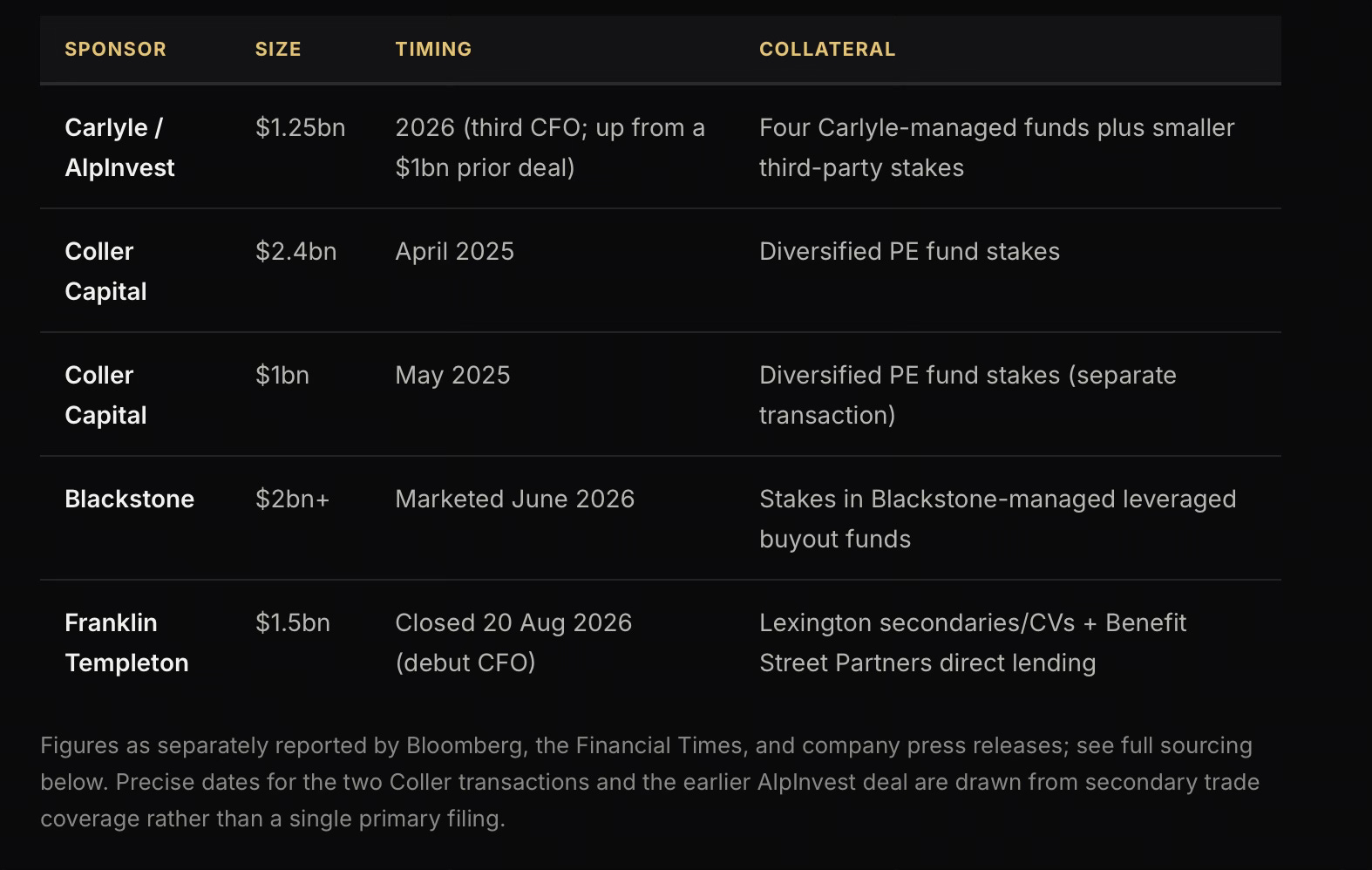
Carlyle’s AlpInvest has been the most prolific single issuer, scaling its CFO program from roughly $1 billion in an earlier deal to $1.25 billion in what press coverage described as the largest publicly rated GP-led CFO to date: a pool bundling stakes across four Carlyle-managed funds alongside smaller third-party positions, with the equity tranche sold almost entirely to insurers and family offices. Coller Capital has been active on a similar scale: Bloomberg reported a $2.4 billion Coller CFO in April 2025, among the largest on record, followed by a separate $1 billion Coller securitization the following month, two distinct transactions in the same window rather than one deal restated, worth flagging since not every write-up distinguishes them cleanly.
Blackstone was reported by the FT in June 2026 to be marketing a CFO backed by more than $2 billion of its own stakes in leveraged buyout funds, one of the clearest signals yet that even the largest alternative asset managers see this as a mainstream financing tool rather than a niche one. And Franklin Templeton closed its own debut CFO on August 20, 2026, at $1.5 billion: notable to this audience specifically because the collateral pool blends Lexington Partners secondaries and continuation-vehicle positions with Benefit Street Partners’ direct-lending book inside a single structure; the same secondaries-plus-credit hybridization this newsletter has been tracking elsewhere this year, from Tikehau’s Private Debt Secondaries platform to PGIM’s credit-secondaries build-out on top of its Montana Capital Partners acquisition. Ares Management and Neuberger Berman have also priced CFOs of their own.
The insurance math
The regulatory mechanism driving all of this is a capital-charge gap. A direct LP stake in a private equity fund sits in an insurer’s alternative-assets bucket and typically draws a risk-based capital charge in the range of 30–45%. A rated senior note, whether inside a CFO or the closely related rated-note-feeder structure, can draw a charge closer to 1%, because it’s booked as a bond, not an equity position. That gap is, by most accounts, the entire commercial reason this product exists: insurers get PE-like yield without the PE-sized capital hit, and sponsors get access to the single largest pool of long-duration institutional capital in the financial system.
Europe is earlier in the same process. The UK’s Solvency II overhaul, branded Solvency UK, broadened matching-adjustment eligibility last year from assets with strictly “fixed” cash flows to assets with merely “predictable” ones, which in theory opens a path for UK insurers into CFO paper. In practice, structurers have had to stretch CFO maturities out to 20-plus years, well beyond the traditional 12–15-year range, to qualify, Churchill Asset Management’s $750 million NPC SIP 2024-1 transaction, built around a 30-year bond with a 25-year reinvestment period, is the reference deal for that approach. One structured-finance lawyer quoted in trade coverage described actual European insurer participation as still “miniscule” next to the U.S., with real EU capital-charge relief anticipated rather than delivered. That’s the honest read: European insurance capital is a real destination for this product, but it’s a 2027–2028 story, not a 2026 one.
That early-stage read is also where the industry’s own conversation has landed. Closing remarks at IPEM’s Secondaries Summit specialization panel this year pointed to CFOs as the genuine “next frontier” for the asset class, a securitization-based liquidity tool expected to become increasingly relevant, particularly for the European market. The same closing remarks paired that with an explicit caution worth taking seriously given everything above: CFOs can be an efficient capital tool without yet being widely understood by the investors buying into them. That’s not a knock on the structure so much as a description of exactly where it sits on its own adoption curve, the same framing IPEM’s LP survey data used for secondaries generally, now one step further downstream into the plumbing.
“From last year going into this year, we’ve seen more structured [debt] designed to attract investors with different risk tolerances.”
THOMAS SPELLER, CO-HEAD OF FUNDS RATINGS, KBRA
The skeptics
Not everyone is comfortable with how fast this has scaled, and the discomfort isn’t limited to outside academics. The NAIC itself has been tightening its own oversight of the exact structures it opened the door to: its Securities Valuation Office gained discretion in August 2024 to challenge CFO ratings directly, a January 2026 reform let the SVO strip a rating and assign its own internal designation, and a formal Due Diligence Framework for these instruments was exposed for public comment in May 2026. Read alongside the broader risk-based-capital overhaul the NAIC adopted for CLOs and collateral loans in mid-2026, the pattern is a regulator opening a channel for insurance capital while simultaneously building the machinery to police what actually flows through it.
The sharper critique comes from academia. Ludovic Phalippou, the Oxford professor best known for his skepticism of private equity fee structures, put the comparison bluntly in reporting on the trend: “You’re taking illiquid, opaque assets, slicing them up, and selling tranches with theoretical diversification.” The parallel he’s drawing is deliberate, pre-2008 CDOs also bundled opaque assets into tranches and relied on diversification to justify top ratings for the senior slice. Even coverage sympathetic to the CFO market’s growth has flagged the structural point that both CFOs and tranched NAV loans layer leverage on leverage, since the buyout portfolio companies sitting at the bottom of the structure typically already carry meaningful debt of their own.
And the honest caveat, which the market’s own boosters concede: nobody has yet watched a CFO structure absorb a full credit cycle. Duration risk, mark-to-market exposure in a genuine downturn, and how thin secondary-market liquidity for CFO notes themselves would hold up under stress are all, in Dechert’s own words from its 2026 market update, still open questions rather than answered ones.