


Fabrice Moyne closed his first secondaries transaction in 2007, when he was managing the private equity portfolio of the University of Minnesota Foundation. The track record he built there, he says, became the basis for Mantra Investment Partners’ first secondaries fund. He went on to spend more than 11 years at the Paris firm, as a partner from day one and as the person who built its secondaries business.
It was never his firm. “Mantra was controlled 100% by one individual” he says. “I was a partner since the day I started and I was head of secondaries. And in fact, I built entirely the secondary program from scratch. But it was not really my firm and as an example, I was not allowed to be involved in the review of the investment professionals within my team.”
He was 43 when he and Mantra parted ways in 2022. “I always had this ambition to build something with the right governance, with the right culture,” he says. “And it was at the time now or never, because otherwise I would have been too old to start something.”
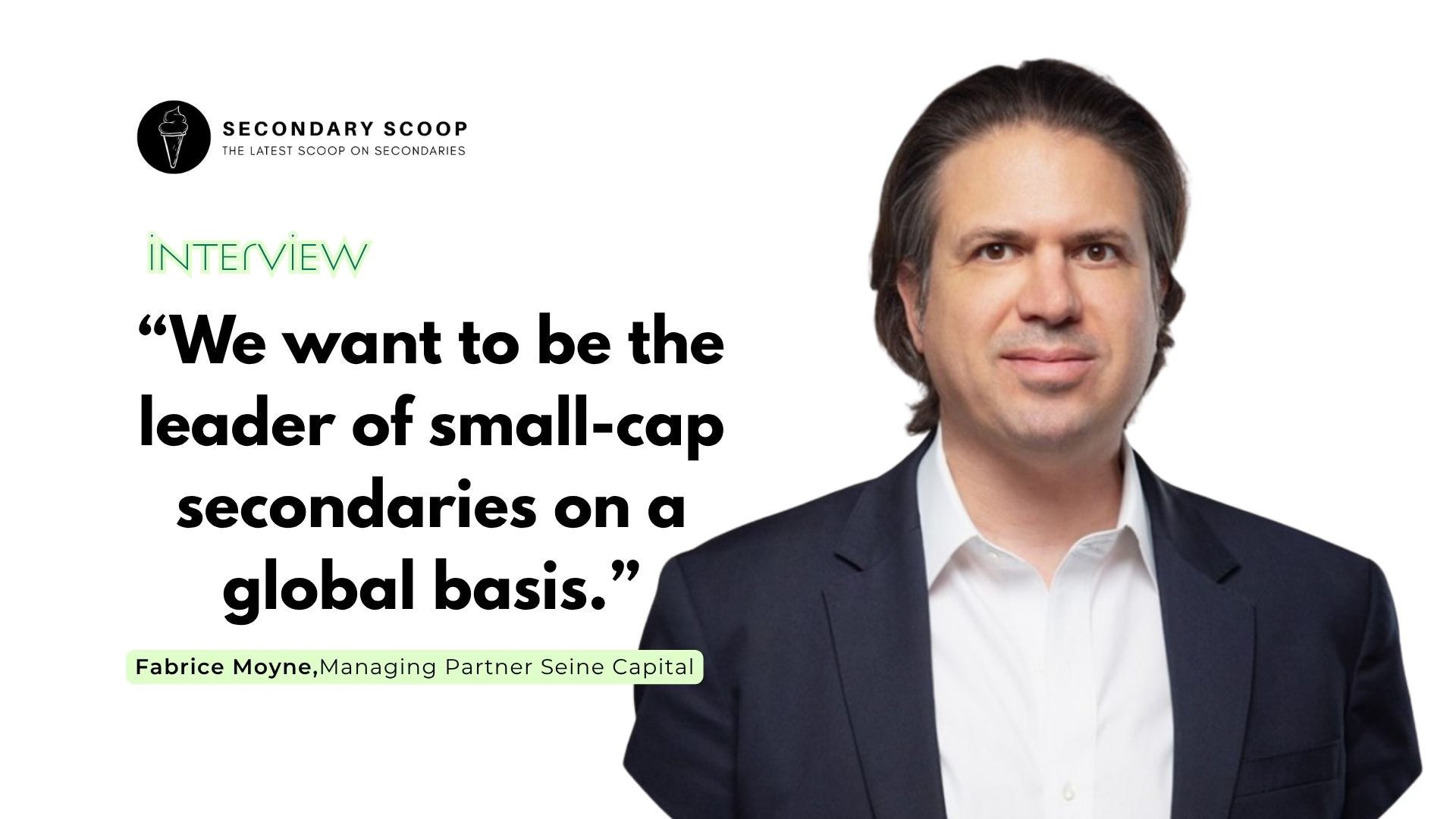
The result is Seine Capital, a Paris-based buyer with offices in Switzerland and Luxembourg and a partner in Dallas. Its debut fund, Seine Capital Liquidity Solutions, closed this spring at $180m, 20% above its $150m target. The ambition is not modest: “We want to be the leader of small cap secondaries on a global basis.”
A market that plays in the buyer’s favor
Seine’s edge, as Moyne describes it, comes down to size. “The main focus and the main differentiator are the deal size that we target, typically transaction[s] between 3 and 15 million,” he says. About 70% of the fund goes to LP-led deals, usually single LP stakes or small portfolios of no more than five funds. The underlying funds typically range from 150 million to 750 million in size.
At that scale, few buyers show up. Moyne says Seine either has exclusivity from day one, through proprietary sourcing or small intermediaries it knows well, or competes in “very small processes where typically there are no more than three other potential buyers.” The imbalance does the rest. “There’s so much supply for smaller deals versus more limited demand that the market really plays in the buyer’s favor,” he says.
Smaller managers are also more forthcoming. “Smaller GPs tend to open their books a lot more,” Moyne says, and they often share information in writing that they don’t give to their own LPs. That lets Seine model each of the five to 20 underlying companies in a typical deal one by one. “Zero statistical analysis whatsoever,” he says.
The outcome shows up in pricing. Seine typically buys LP stakes at discounts of 30% to 50%. Across Fund I’s LP-led deals so far, the average discount is exactly 50%, “which is obviously significantly greater than the discount you would see on the market.” Seine also buys later than most. Moyne puts most market volume between years three and eight of a fund’s life. Seine typically trades between years seven and 12. “We are not Hollyport. We are not a [tail-end] specialist, but we are certainly buying things that are more mature than your typical buyer.”
“I could care less whether we do a transaction at a premium or whether we do it at a 60% discount. What we care about is the actual performance of the deal.”Fabrice Moyne, Seine Capital
He is quick to add that the discount is not the point. “We’re absolutely not discount seeker[s],” he says. For Seine, the discount is “the variable of adjustment to achieve the targeted return.” Every deal is underwritten to a maximum price that clears 2x, a 25% IRR and DPI breakeven within three years. “We see deals all the time on the market that we could do at 70, 80, 90% discount. And we absolutely don’t want to touch them because we think there will be poor transactions no matter what the price you pay for them.”
No leverage, not even a capital call line
The firm’s most unusual choice is what it leaves out. “We don’t use any leverage whatsoever,” Moyne says. “We don’t even have a line of credit to bridge capital call[s].”
His reasoning is about who gets the cash. “When you distribute cash received from your portfolio, at least early on, it goes towards the leverage provider, not towards your LPs,” he says. “And so, your portfolio might be generating DPI, but your LPs don’t see it.”
He thinks leverage props up returns elsewhere in the market. Look at how some mid-sized and larger funds generate performance, he says, “and you will see that if you remove the leverage, it doesn’t look that attractive.” He doesn’t rule it out forever. “Maybe one day we will for a reason or another. But in the current fund, we’ve told LP[s] that we wouldn’t, and obviously we don’t.”
The DPI target is the hardest of the three, he admits, “but it forces us to be extremely focused.” The early numbers he shares are strong. Two SPVs closed in the first quarter of 2024, before the fund’s first close, have returned more than 1x DPI and sit at about 2.5x on a combined basis. The fund’s second transaction reached DPI breakeven in under two years and has fully realized at more than 3x. Excluding deals closed in the past six to seven weeks, he puts Fund I’s DPI above 25%.
GP-leds, on Seine’s terms
Moyne expects GP-leds to keep gaining ground. He puts the market at roughly 50-50 today and sees GP-leds reaching about two-thirds by 2035. “The GP led market is becoming a real route of exit for private equity funds,” he says. “In LP led transactions, you only solve liquidity for an LP.” He also sees the segment as “significantly underserved,” given how many more companies could go through a GP-led than do today.
Seine, however, doesn’t plan to follow the market. Its target is 70% LP-led, 20% to 30% GP-led and up to 10% direct secondaries. Today the portfolio is over 80% LP-led, about 16% GP-led and about 2% direct. “LP led is our bread and butter,” Moyne says.
The constraint is the three-year DPI test. Most continuation vehicles are set up for at least five years plus two one-year extensions, so an early exit is unlikely, especially for a single asset. Seine focuses on CVs of no more than 100 million and screens hard. “For one of those, you have to look at 200 deals,” he says. That means single-asset deals with an exit in sight, multi-asset deals where one or two companies should sell early, or, in its most recent GP-led, a single asset where Seine expects a large dividend recap to return most of its capital within three years.
“Your portfolio might be generating DPI, but your LP actually don’t see it.”Fabrice Moyne, on why Seine doesn’t use leverage
An open book, inside and out
Transparency comes up again and again. Seine shows its LPs where it sourced every deal and gives them the full investment committee memo on the day a transaction closes, through its data room. Prospective LPs may get access to the same material under NDA.
Moyne is critical of how some managers present performance. He describes buyers in deals with deferred payments who net later distributions against the second payment, which lowers their cost basis and inflates the multiple. “For me, it doesn’t make sense,” he says. “But some people are showing returns like this. In fact, more and more are.” Seine’s aim, he says, is “to be as easy to read and due diligence as possible and not use any artifice to pretend we look better than we actually do.”
He doubts guidelines alone would fix it, since managers aren’t bound to follow them, but he trusts the buy side. “A lot of LPs are smart enough to understand what’s going on, to properly analyze track records and to really understand what’s behind them as opposed to take all the numbers put in front of them for granted.”
The same logic applies inside the firm. Seine has eight people, and carried interest is shared across the team. “Even our most junior analysts have some meaningful carried interest,” Moyne says. “There’s no politics involved whatsoever. It’s all about performance.”
A first-time fundraise, and a date to keep
The fundraise was “not as easy as it may seem,” Moyne says. In July 2024, Seine told prospective investors it was targeting a first close of $30m to $50m in mid-October. It closed $70m on October 15, the exact date it had set. Then the money slowed. Through the end of 2025, the team raised very little and focused on deploying. It had promised an 18-month window to final close, and Moyne “absolutely didn’t want to use any extension.” Momentum returned in 2026, and the fund closed on April 15 above target. “But again, in [20]25, we were actually very, very nervous.”
The LP base surprised him. Institutions make up about two-thirds of the fund, led by a US university endowment that is the single largest investor, alongside eight funds of funds and asset managers in Europe, the Middle East and North America. “Absolutely unexpected,” he says of the funds of funds, “because I didn’t even think that [fund of funds] were committing to secondary funds.” Family offices, typically writing $3m to $10m checks, account for nearly 30%, and ultra-high-net-worth individuals another 4% to 5%.
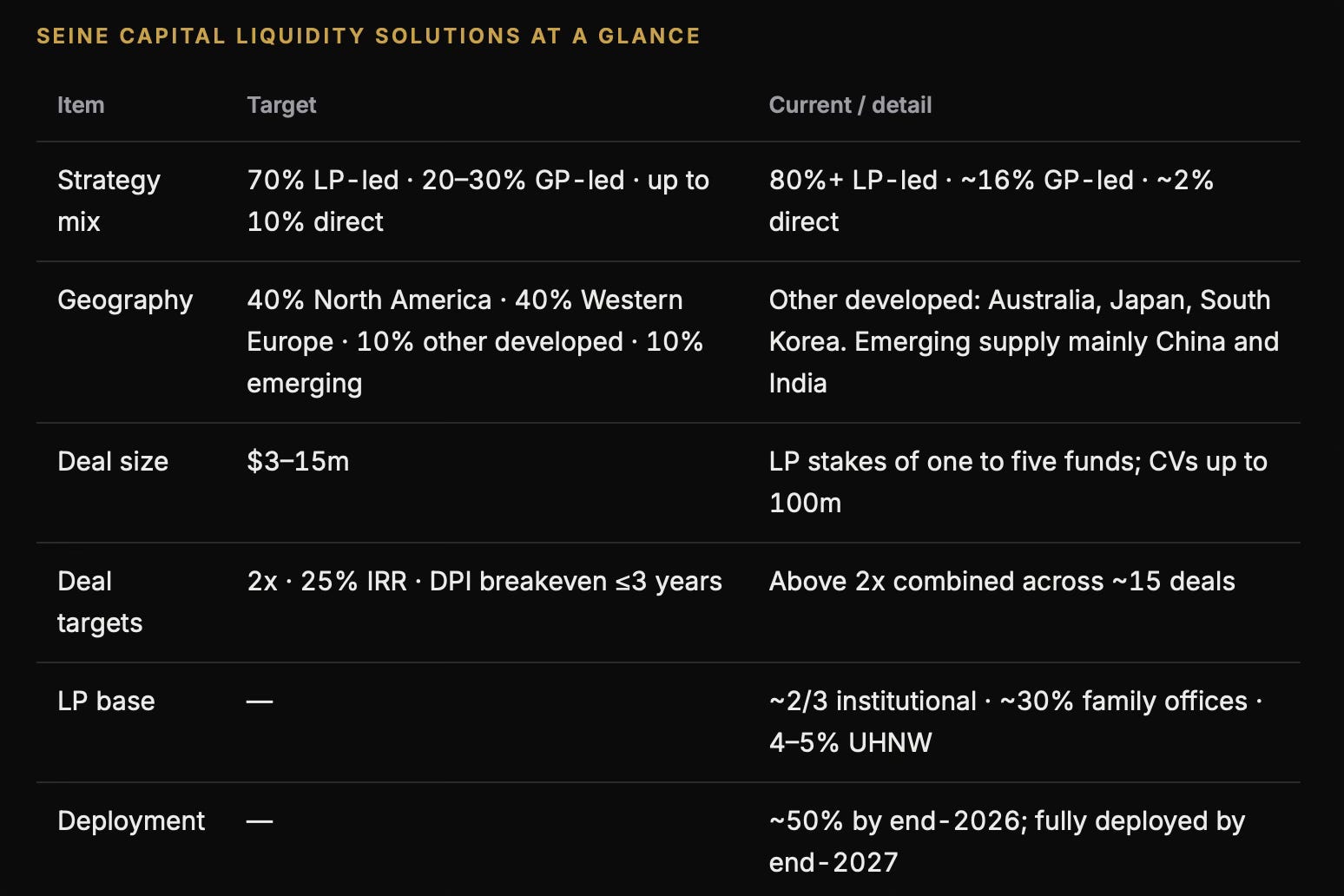
Geography matters less than it looks. Seine is based in Paris, but Moyne says the LP-led market runs on phone and email. “As long as you have the right contact, it doesn’t really matter if you’re based in Paris, in New York, in Tokyo, or on a remote island in the middle of the Pacific.” Partner Chad Zidow works from Dallas, where the firm plans to open a formal office and hire. The one real difference between the two markets, Moyne says, is the seller base. In North America Seine can buy from endowments and foundations. In Europe, very few of them hold private equity portfolios.
The next fund is already on the calendar. Moyne expects Fund I to be about 50% deployed by year-end and fully deployed by the end of 2027, which means a successor needs a first close by then. Seine held its first annual meeting on October 15 this year, and that was no coincidence. Moyne would like the next first close to land on the same date. In 2027, October 15 falls on a Friday.
ABOUT SEINE CAPITAL
Seine Capital is a secondaries investor focused on transactions of $3m to $15m across LP-led, GP-led, preferred equity and direct secondaries. It was founded by Managing Partner Fabrice Moyne, formerly head of secondaries at Mantra Investment Partners, with partners Chad Zidow and Sol Zein. Its debut fund, Seine Capital Liquidity Solutions, held a $70m first close in October 2024 and a $180m final close in April 2026. The firm has offices in Paris, Steinhausen (Switzerland) and Luxembourg. Source: Seine Capital.
Very nice report. A more detailed description of how deferred payments work and how they distort reported economics would have been great.
As i understand it, to the extent that a secondary transaction includes a deferred payment, the discount to NAV is in effect understated.
For example: I sell you my stake in fund X at 90% of NAV. However, you don't pay me all of the money today: instead you make 2 payments, half today and half in a year.
Time value of money says that really, the transaction is at a larger discount to NAV than disclosed. The seller saves face (they sell fund X for an optically smaller discount--in fact the discount is larger).
I'm embarassed for the selling LPs that do this and pretend the reported prices can be compared with non-deferred payment transactions.
I'd be curious to know what percentage of the secondary transaction volume has deferred payments tied to it and what the trends are.