Joe Baratta is leaving Blackstone by the end of the year after 28 years, the firm confirmed on Friday. He ran its private equity business from 2012 and was one of only three executives on Blackstone’s board, alongside Steve Schwarzman and Jon Gray. According to an internal memo, says Bloomberg, nobody will replace him.
Most coverage has treated the departure as the end of the star-dealmaker era at the world’s largest alternative asset manager. For Secondary Scoop, one detail matters more. Blackstone’s secondaries franchise, Strategic Partners, is one of the largest in the world, and Baratta never built it, never ran it, and was never its public face.
How the firm grew that business while he ran buyouts says a lot about where Blackstone is heading.
The buyout architect
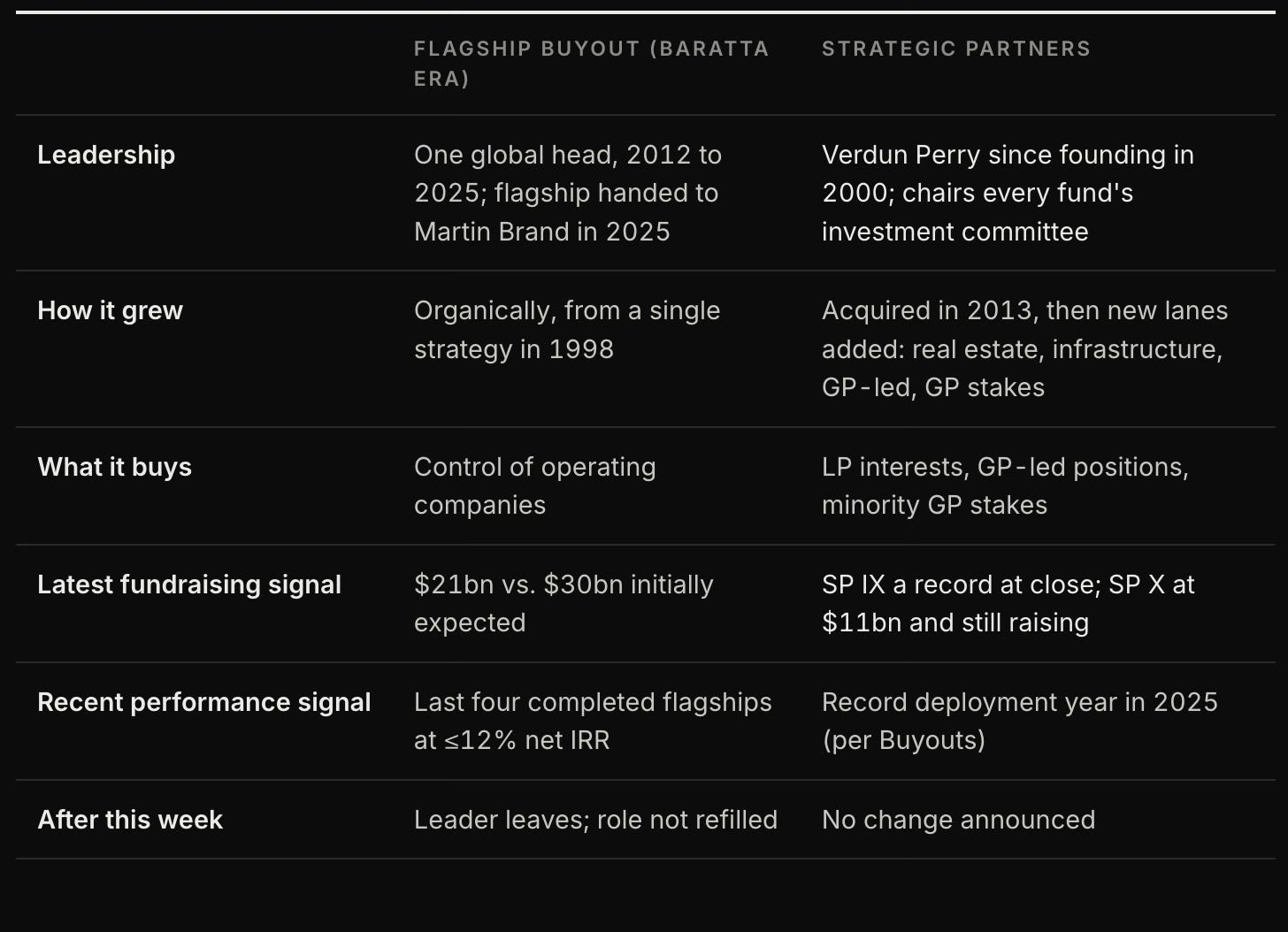
Baratta joined Blackstone in 1998, when the firm had just closed its third flagship buyout fund and ran a single private equity strategy. In 2001 he moved to London to set up the European private equity business. He became global head of private equity in 2012. Deals he worked on include Merlin Entertainments, the Legoland owner, and Hilton, where Bloomberg reports Blackstone ultimately tripled its investment.
In January 2025 he moved up to a newly created role, global head of private equity strategies, which Bloomberg says required all fund heads in that category to report to him. At the same time, tech dealmaker Martin Brand took over day-to-day management of the flagship fund. Many insiders read the promotion as a step toward his exit, Bloomberg reported.
His later record is mixed. The four most recent flagship funds that have finished investing all showed net IRRs of 12% or less at the end of June, according to Bloomberg. The latest flagship raised $21bn against initial expectations of $30bn.
“Given the strength of the leaders for each of our dedicated PE verticals today, we do not intend to replace Joe’s role.”
Steve Schwarzman and Jon Gray, internal memo to employees, as reported by Bloomberg
The business that ran on its own clock
Strategic Partners did not come out of Blackstone’s buyout culture. Stephen Can founded it in 2000 inside Credit Suisse, and Verdun Perry joined at its founding. Blackstone agreed to buy it in April 2013, the year after Baratta became global head of private equity. At the time it had $9bn in assets under management.
Tony James, then Blackstone’s president and COO, fronted that deal, not the private equity chief. “Strategic Partners complements Blackstone’s existing businesses, and we expect to be able to grow its franchise and help it enter new product areas,” James said at the time.
It then did exactly that, and largely under the same leadership. Blackstone’s own biography says Perry “chairs the investment committee for each of Strategic Partners’ funds”. Baratta’s biography describes his remit differently: “He currently oversees all of the firm’s directly-invested private equity strategies.” A fund-of-funds secondaries business that buys LP interests in other managers’ funds falls outside that definition.
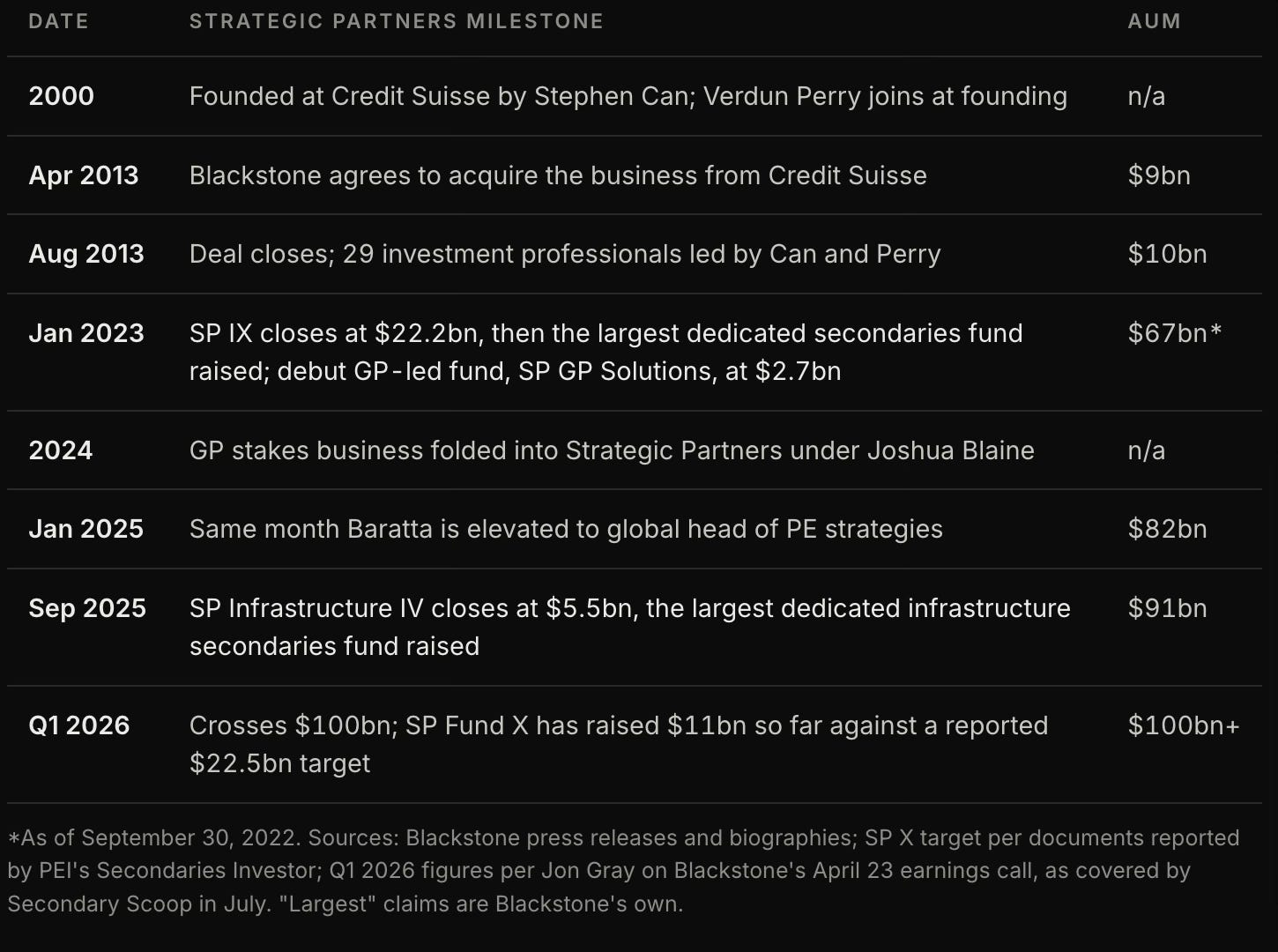
So the business grew tenfold in 13 years through a path separate from the buyout chain of command. It added new lanes one at a time, each with its own head. Mark Burton runs real estate secondaries, Mark Bhupathi runs infrastructure secondaries and Joshua Blaine runs GP stakes, all under Perry.
There is one gap we could not close. Bloomberg describes Baratta’s 2025 role as covering all private equity fund heads, and Blackstone reports Strategic Partners inside its private equity segment. We found no public source confirming that Perry reported to Baratta. When Baratta was promoted, Bloomberg put the teams he would lead at around $210bn. By June 30, 2025, the full private equity segment held $389bn, according to a BXPE filing. The dates differ, but the gap between those two figures suggests his remit never covered the whole segment. That is our inference, not a confirmed fact. Perry is also absent from the list of PE leaders Bloomberg names as the post-Baratta bench.
Why a secondaries arm sits apart from the buyout funds
A buyout fund buys control of companies. A secondaries fund buys positions in other people’s funds: LP stakes sold by pensions and endowments, or stakes in continuation vehicles set up by sponsors to keep hold of assets. Its counterparties are the same GPs the firm’s buyout teams bid against for deals.
That creates practical reasons for a separate chain of command, such as keeping pricing on third-party deals independent and managing conflicts when a sponsor’s own funds come to market. Blackstone has not described how it handles this internally. The general logic is why many large platforms run secondaries as a distinct unit rather than as a sleeve of the buyout business.
What that tells us about where Blackstone is going
Bloomberg’s second report describes Blackstone moving away from a firm dominated by a handful of star investors toward “a sprawling institution” built on a wider bench of leaders with narrower responsibilities. Real estate has already gone to co-heads to limit key-person risk. Private equity now splits across Martin Brand (core PE and the flagship funds), Jas Khaira (Blackstone N1), Viral Patel (BXPE) and Chris James (Tactical Opportunities).
Strategic Partners has worked this way for years: one long-tenured global head, specialist lanes with their own leaders, and a franchise brand that matters more than any single dealmaker. Three signals suggest this is the direction for the whole firm.
1 · GROWTH IS COMING FROM OUTSIDE THE FLAGSHIP
Blackstone’s private equity assets rose 17% year on year in the second quarter, Bloomberg reports, but that bucket includes infrastructure, secondaries and Tactical Opportunities. The flagship buyout fund fell well short of its fundraising expectations. Secondaries has been raising funds at record scale. Blackstone does not break out how much of the 17% came from each strategy, so we cannot say how much secondaries contributed. The direction is still clear. Gray said in July 2025, referring to secondaries: “The returns have been very strong over time in this area, and that’s making it attractive to investors.”
2 · SECONDARIES FITS THE RETAIL MACHINE
Gray’s central project is turning Blackstone into a manager for individual and retirement savers. BXPE, the evergreen private equity fund launched in January 2024 and now run by Viral Patel, already has a place for Strategic Partners. Its disclosures state that “investments are generally classified as Secondaries if they are sourced by Strategic Partners or structured as passive equity co-invest positions.” The sleeve is still small, at 4% of the portfolio as of March 31, 2025, according to a third-party analysis of BXPE’s reporting. Secondaries brings diversified, already-seasoned exposure and earlier cash flows, which suits a semi-liquid vehicle that has to meet redemptions. Perry has been talking up retail access since at least 2022, when he told an IPEM audience that the arrival of retail investors was among the biggest changes in the asset class.
3 · THE INSTITUTION IS THE BRAND
Strategic Partners’ fundraising copy does not sell a dealmaker. It sells scale: roughly 2,400 transactions since 2000 and “the power of the Blackstone Strategic Partners brand,” as Perry put it when SP Infrastructure IV closed. That is the pitch Gray now needs across the firm, because retail distribution runs on brand and process rather than on individual reputation.
“With substantial scale and our multi-strategy footprint, we believe we are well-positioned to capitalize on the vast, and growing, opportunities across the secondary market.”
Verdun Perry, Global Head of Blackstone Strategic Partners, January 2023
Baratta’s real secondaries legacy may be supply
Baratta leaves a mark on secondaries through the buyout portfolio he oversaw, not through the secondaries team. Bloomberg describes an industry weighed down by a backlog of unsold assets bought at high prices when rates were low. Blackstone’s recent flagships show that in their returns. Assets held too long in funds nearing the end of their lives are exactly what the GP-led market exists to handle.
One example has already surfaced. In October 2025, A Media Operator cited industry sources saying Blackstone could consider a continuation fund with a minority investor for Clarion, which it has owned since 2017, after a sale process stalled. The same report said Clarion was likely held in the 2015-vintage BCP VII, whose life runs to the end of 2027. That remains speculation, and Blackstone has not announced any such deal. But it shows the kind of decision Martin Brand’s team will face across the vintages Baratta leaves behind: sell into a weak market, extend, or run a continuation vehicle.
If those GP-led processes happen, the obvious question is who leads the pricing. Blackstone’s own secondaries franchise is one of the few buyers big enough to anchor large deals. It is also on the same side of the table as the seller.