


Two days before Tikehau Capital published its third-quarter update, Bloomberg reported that the Paris-listed manager is looking for a new strategic investor. The Q3 numbers released on October 22 make the logic of that search easier to read. The fee engine is holding, the platform returned more cash to clients in the third quarter than in any other quarter of the year, and its credit secondaries franchise has just moved into a perpetual, semi-liquid format built for continuous fundraising.
What the quarter also shows is a gap between the platform’s momentum and the 2026 milestones Tikehau set in February. A partner with capital and distribution is one way to close it.
Credit secondaries moves to an evergreen format
The most significant secondaries disclosure in the release is structural. Tikehau held the first close of the third iteration of its Credit Secondaries strategy, and unlike its two predecessors, it is structured as an evergreen, semi-liquid vehicle. A Korean institutional investor anchors it. Tikehau describes the mandate as capturing opportunities across the full spectrum of credit secondaries throughout the cycle.
The franchise has scaled quickly. Tikehau entered credit secondaries in 2019, and in February 2026 it closed Tikehau Private Debt Secondaries II on more than $1bn, above its $750m target and more than double the size of the first vintage. Moving the third iteration into a perpetual structure changes the economics of the business: capital stays invested and compounds rather than being returned at the end of a fund life, and fundraising becomes continuous rather than cyclical.
The format also fits the strategy Tikehau laid out at its February 2026 strategic update, which named semi-liquid vehicles among the tools for widening private wealth access to its products. The Korean anchor fits the distribution story too. In H1 2026, roughly 60% of Tikehau’s third-party net new money came from investors in Germany, Israel, South Korea and the US.
The release does not disclose the size of the first close, a target, or the vehicle’s liquidity terms. We will report those when Tikehau publishes them.
DEPLOYMENT PICKED UP WITH VOLATILITY
Tikehau said deployment in Credit Secondaries accelerated in Q3, as market volatility created more opportunities at attractive entry points and better valuations. The marquee deal: Tikehau acted as lead investor in a ~$215m GP-led secondary across a portfolio of performing US first-lien loans.
Two details stand out. First, this is a GP-led transaction. Earlier in 2026, Tikehau’s head of private debt secondaries, Pierpaolo Casamento, described TPDS II’s focus to Mergermarket as LP-led credit secondaries, even as the wider market pivoted toward GP-leds. Leading a GP-led deal of this size shows the team now competes on both sides of the market. Second, the underlying loans are performing. The transaction is a portfolio management tool, not a distress trade.
“Real Assets and Credit Secondaries continued to gain momentum, and our deployment remains disciplined in a market that rewards selectivity.”
Antoine Flamarion and Mathieu Chabran, co-founders of Tikehau, Q3 2026 release
That the founders single out Credit Secondaries in a two-strategy shortlist matters. In a quarter where group-level fundraising slowed, it is one of the two lines management chose to highlight as growing.
The partner search: what is new and what was already on record
According to Bloomberg’s October 20 report, which cited people familiar with the matter, Tikehau has held talks with several international firms and investors about selling a stake in itself and has mandated an investment bank to run a process that has been underway for several months. Tikehau declined to comment to Bloomberg, and the Q3 release does not address it.
The direction itself is not new. Tikehau has been laying the groundwork in public all year:
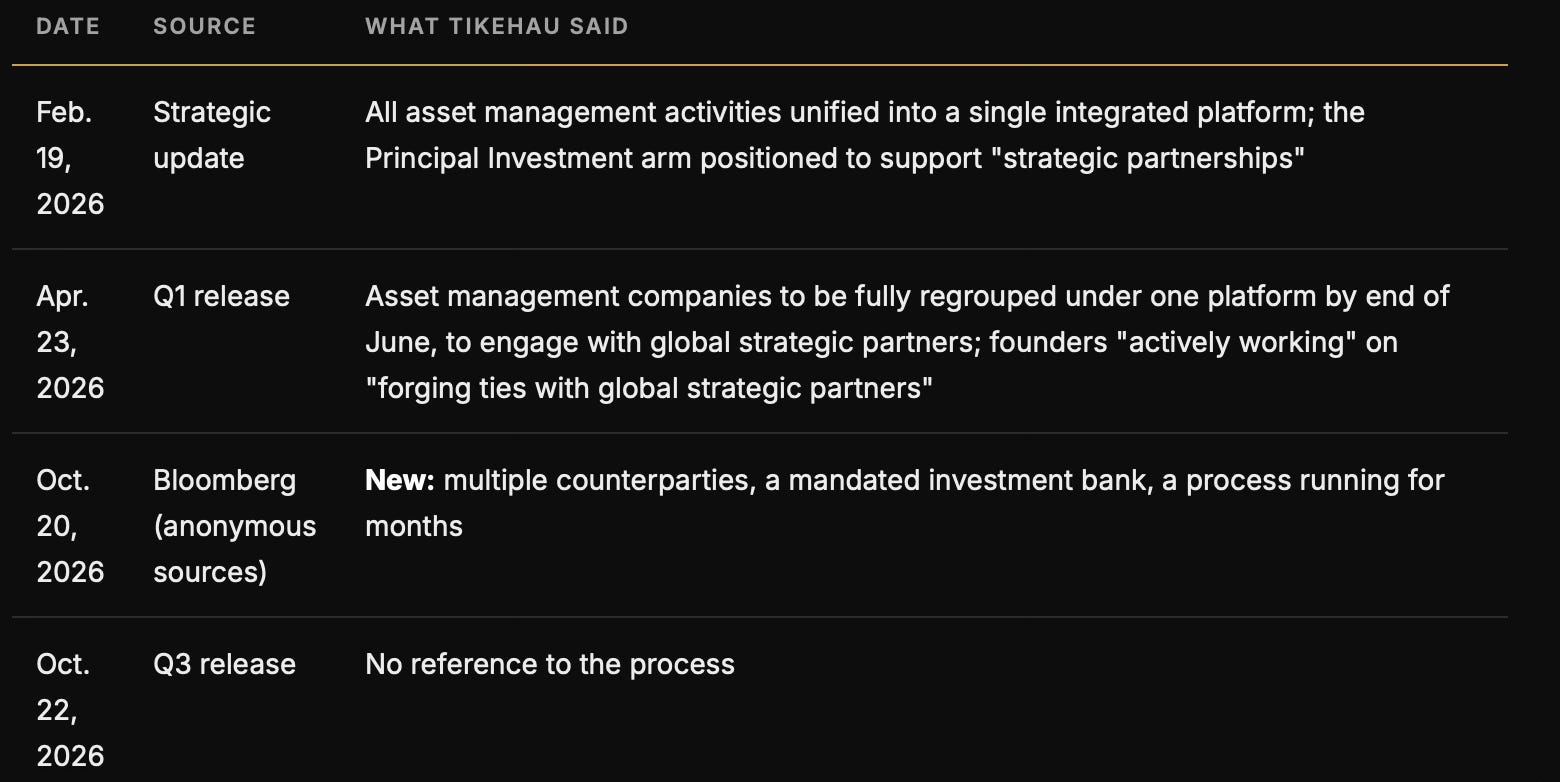
Sources: Tikehau Capital press releases of February 19, April 23 and October 22, 2026; Bloomberg, October 20, 2026.
Bloomberg places the move within a wider trend of asset managers seeking strategic backers for capital, distribution and acquisition firepower. It notes that Wendel hired advisers last month to find partners for its private asset platform, and names Blue Owl, Blackstone and Goldman Sachs’ Petershill Partners among the most active buyers of stakes in alternative managers. Tikehau’s existing backers include its founders, who retain control, MACSF and Temasek.
ADJACENT, NOT THE SAME
A minority stake in Tikehau Capital would be a GP-stakes transaction: capital going into the management company. That is adjacent to the secondaries market but is not a secondaries deal, and we will not count it as one. The secondaries story here is the credit secondaries franchise itself, which a stake buyer would acquire exposure to.
Why scale is the question
In February, Tikehau reset its 2026 milestones to reflect a tougher macro and geopolitical backdrop. The Q3 update shows the fee business tracking the lower end of that range, while the portfolio-driven targets have slipped.
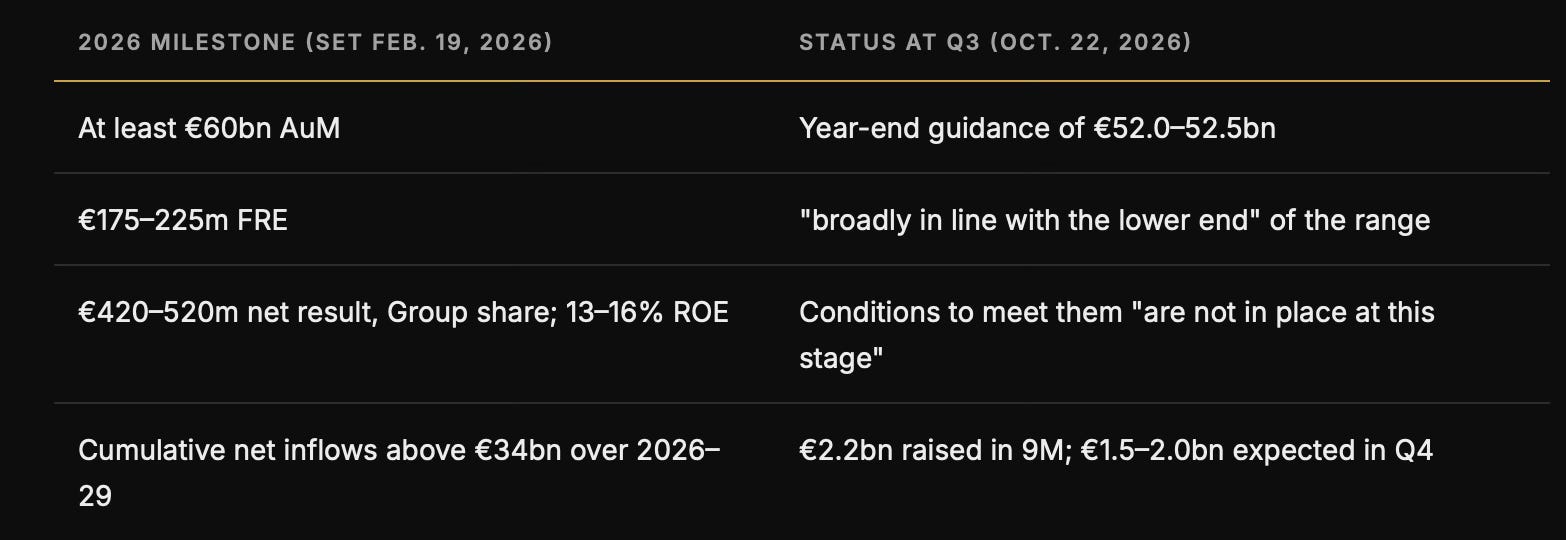
Sources: Tikehau Capital strategic update (February 19, 2026) and Q3 2026 release. AuM guidance assumes constant AuM in Capital Markets Strategies.
The distinction matters. Tikehau attributes the net income and ROE shortfall to portfolio revenues, in particular unrealized marks on its €4.0bn balance sheet, rather than to the fee-paying business. Fee-paying AuM rose 6% year on year at constant perimeter to €42.5bn.
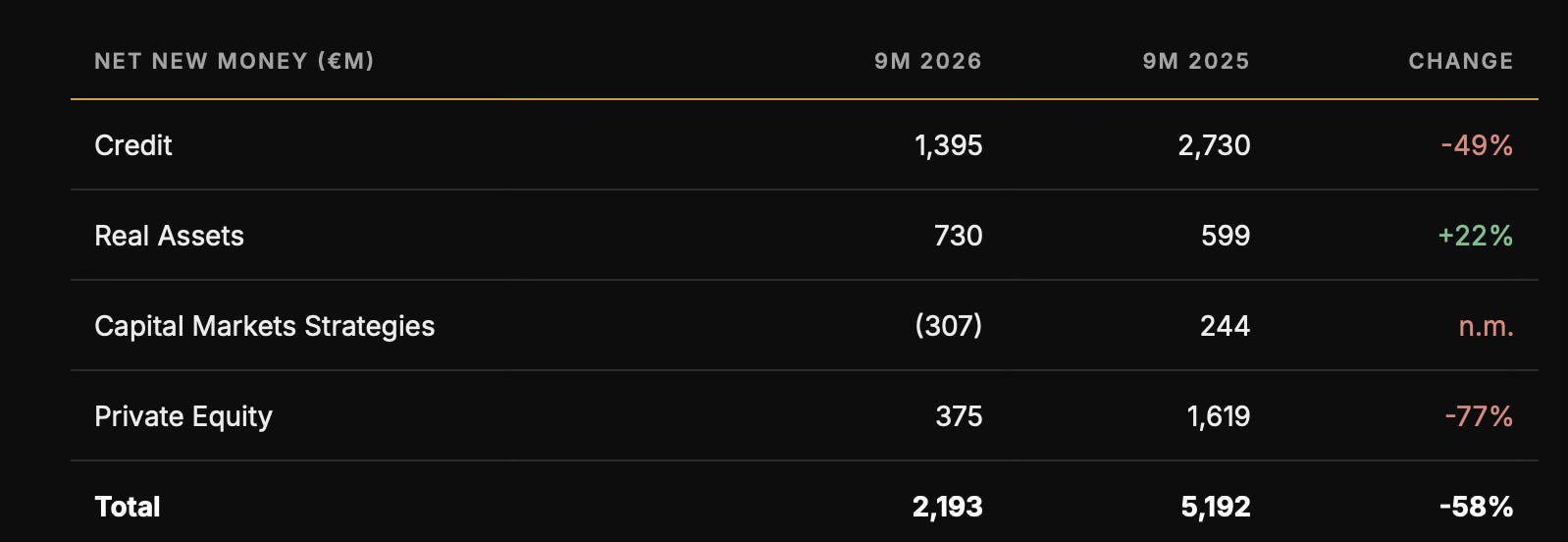
Fundraising is where a strategic partner would make the clearest difference. Net new money for the first nine months fell 58% year on year, with Private Equity down the most:
A strong quarter for liquidity
On the realization side, the quarter delivered. Tikehau returned €2.2bn to LPs year to date, including €1.1bn in Q3, its highest quarter of the year, driven by exits and by Credit and Infrastructure funds entering their post-investment phase. Highlights:
Aubert & Duval exited from the Aerospace & Defense strategy for ~€260m.
The third Direct Lending vintage was fully liquidated: launched in December 2014, 31 companies, 9.4% gross and 8.1% net IRR.
Five Private Equity exits year to date at an average 1.7x gross MOIC, with three more signed exits expected to close in Q4.
On the balance sheet, the Schroders exit returned €369m, at 1.65x gross MOIC and a 64% gross IRR.
Q3 distributions of €1,126m exceeded net new money of €459m. For LPs focused on DPI, that is a good result. For a manager measured on AuM growth, it raises the bar on fundraising, which is exactly where scale and distribution from a partner would help.
One reminder of Tikehau’s own history with GP-leds: the 77% drop in Private Equity deployment year to date partly reflects a high base. Q3 2025 included the ~€775m Egis investment, made through Tikehau’s first private equity continuation fund.