


TPG doesn’t report a secondaries segment, and its secondaries activity doesn’t sit in one place. It’s spread across three parts of the firm. TPG GP Solutions and NewQuest sit in the Market Solutions platform. Continuation vehicles appear in both the Capital and Credit platforms. And as of this quarter, the asset-based finance team in Credit is a buyer of credit secondaries too. Read together, the Q3 materials give the clearest picture yet of how a $346 billion multi-strategy manager uses secondaries both as an investment strategy and as a tool for managing its own funds.
GP-led: GP Solutions is now tied to the GP-led market
In our Q2 coverage, we flagged TGS I and TGS II as a platform to watch but stopped short of calling it secondaries activity, because nothing in TPG’s disclosures said so. The Q3 prepared remarks remove that ambiguity. CEO Jon Winkelried tied the GP Solutions pipeline directly to continuation vehicle demand:
“The industry-wide need for liquidity has continued to propel the GP-led secondaries market, which is on track for another record year and remains the fastest growing part of the PE asset class.”
Jon Winkelried, CEO, TPG 3Q26 earnings call
He went on to say that sponsors “are increasingly using continuation vehicles to extend ownership of their best-performing assets while returning capital to investors,” and that as a result “TPG GP Solutions’ pipeline of high-quality opportunities has grown approximately 35% over the past two years, and we’ve maintained a highly selective conversion rate.” TPG gave no conversion rate or deal count.
The fund tables show the scale. TGS II now carries $2.2 billion of commitments, up from the $1.7 billion shown in the Q2 tables. It is already about 19% larger than its 2022-vintage predecessor, and fundraising isn’t finished: TPG’s fourth-quarter guidance includes “additional closes for our 2nd GP Solutions fund.”

Source: TPG 3Q26 supplemental presentation, Fund Performance Metrics. Per TPG footnote 12, performance information for these funds is as of June 30, 2026. Commitments for funds still raising capital are subject to change.
TGS I’s profile, a 36% net IRR on a 1.3x net multiple, is the short-duration shape typical of a book that buys into assets late in their hold. Only $222 million of TGS I’s $2.2 billion of total value has been realized so far, so the IRR is mostly mark-driven at this stage.
The fund also came up in the Q&A, though no analyst asked about secondaries directly. Asked by Barclays’ Ben Budish about the fourth-quarter outlook, CFO Axel André listed the flagship closes and then added: “Beyond those flagship campaigns, newer strategies are also becoming increasingly meaningful contributors such as Sports, TGS 2.”
WHAT THE PLATFORM TOTALS CAN’T TELL YOU
Market Solutions raised $2.2 billion in Q3 and $4.6 billion year-to-date, but that segment also includes Peppertree, which has raised $2.2 billion for its 11th fund including October commitments. TPG doesn’t break out how much of the quarter’s segment fundraising went to TGS II, and Secondary Scoop isn’t estimating it.
Credit secondaries: a deal done for another GP
The most novel disclosure came from the asset-based finance business, which deployed more than $2 billion in the quarter. Winkelried said:
“This included a first-of-its-kind credit secondaries transaction, where we provided a liquidity solution for a GP’s residential mortgage fund that was nearing the end of its life.”Jon Winkelried, CEO, TPG 3Q26 earnings call
“First-of-its-kind” is TPG’s description, and we couldn’t verify it independently. It also isn’t TPG’s first exposure to credit secondaries. The distinction that matters is TPG’s role. MMDL Continuation I, a $1.2 billion vehicle on TPG’s own direct lending book (covered below), had TPG as the sponsoring GP. This deal has TPG as the buyer, providing liquidity to another manager’s fund. TPG did not disclose the counterparty, the deal size, the structure (continuation vehicle, strip sale or tender) or the pricing.
The deal does show where ABF sits in TPG’s thinking. A late-life residential mortgage fund is collateral TPG’s ABF team already underwrites in its primary business. Using that expertise to price a secondary is the same playbook GP Solutions describes for private equity: sector expertise and scale, applied to assets that need a new owner before the fund’s term runs out.
Continuation vehicles: the house book
TPG’s own continuation vehicles appear in two platforms. The figures below are largely unchanged from Q2. TPG AAF’s line shows no unrealized value, so its 37% net IRR is on a fully realized basis.

Source: TPG 3Q26 supplemental presentation, Fund Performance Metrics, as of September 30, 2026. Q2 column from TPG 2Q26 supplemental presentation. Excludes co-investment vehicles and SMAs.
The dispersion we noted in August still stands. Two 2021-vintage Capital continuation vehicles from the same manager show a 43-point gap in net IRR. MMDL Continuation I has now invested $1.1 billion of its $1.2 billion and made its first distributions, $63 million, but is still too young for TPG to report returns.
One item from Q2 carries forward. TDM, the 2017-vintage Growth fund that Jack Weingart, then CFO, described last quarter as having gotten a continuation vehicle that “crystallized some carry,” is again named among the drivers of year-to-date realized performance allocations. Its table line shows $1.06 billion realized and no unrealized value. TPG has not added a separate line for the vehicle that took over TDM’s assets.
NewQuest: a quarter behind
NewQuest, TPG’s Asia GP-led platform, reports on the same lag as GP Solutions, so the Q3 tables show June 30 figures. The changes from the Q2 disclosure are marginal, with NewQuest V’s investment pace the only real movement.
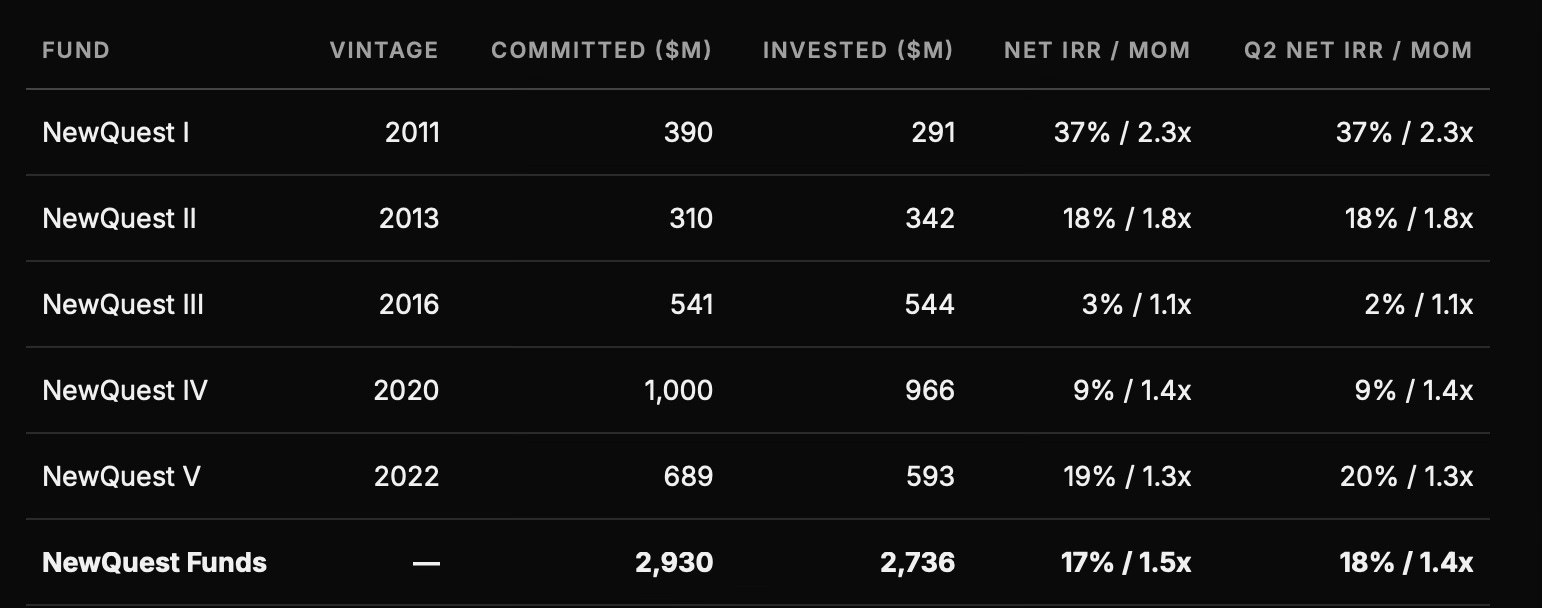
NewQuest V invested another $29 million over the period, which moved its net IRR from 20% to 19%. Nothing in the Q3 call addressed NewQuest or a sixth vintage.
New versus restated
Because much of TPG’s secondaries data repeats from quarter to quarter, here is a strict line between what this print added and what was already public.
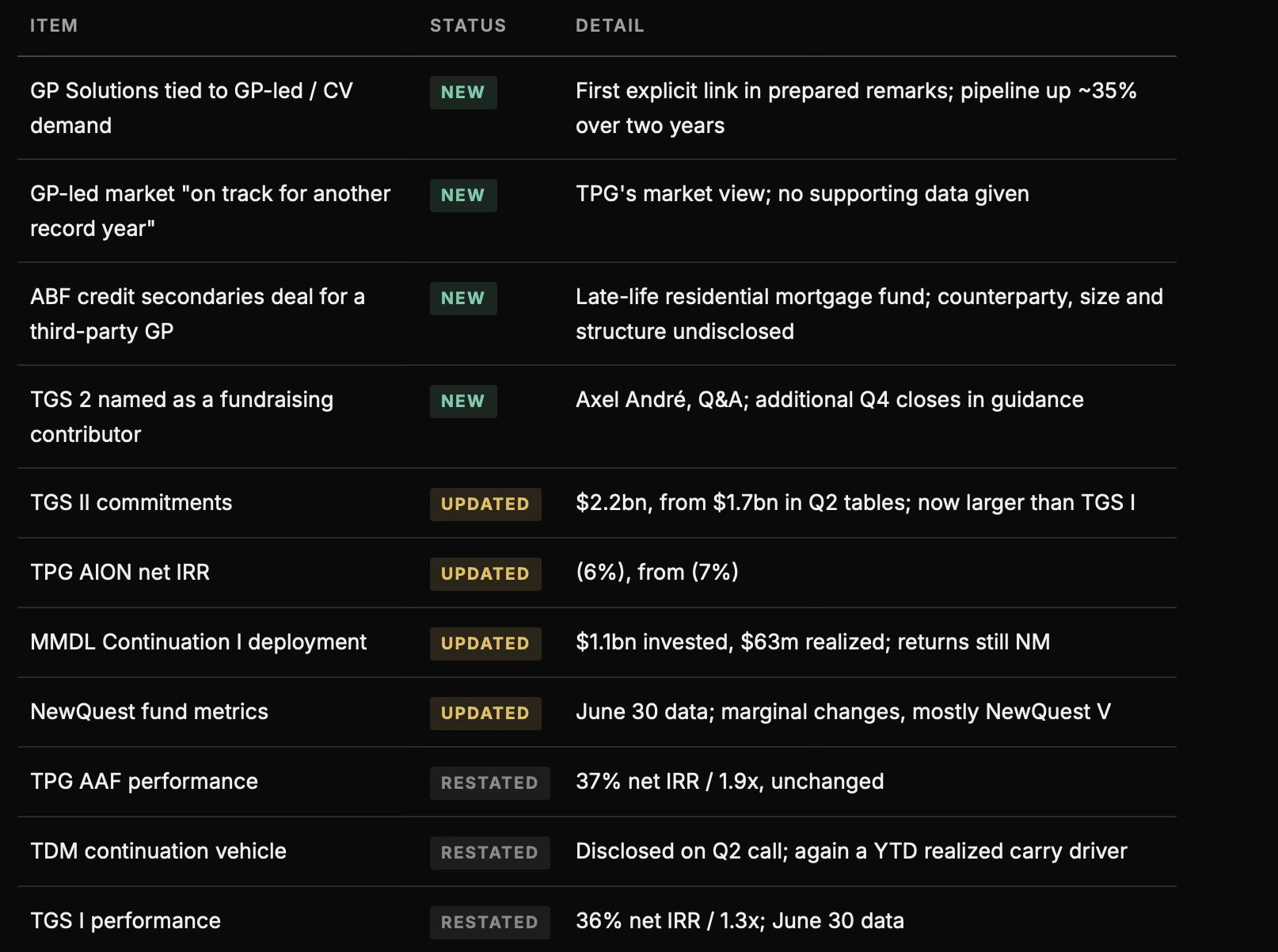
Status reflects comparison with TPG’s 2Q26 materials and Secondary Scoop’s August 2026 coverage.
The liquidity backdrop
The rest of the call explains why TPG is talking up GP-led demand. Realizations of $6.6 billion in the quarter generated just $7 million of realized performance allocations. André attributed this to proceeds being used to return cost basis and cover unrealized losses, mainly in TPG Capital, where the firm marked down software companies facing greater AI-related risk. Net accrued performance still hit a record $1.5 billion.
Asked by Evercore’s Glenn Schorr what supports the expected pickup in exits, Winkelried pointed to over $8 billion of capital returned across TPG Capital, TPG Growth, TCAP and the LSI strategies over the past twelve months, and five signed deals waiting to close. On DPI, he said: “This is something that we’ve been consistent about in terms of focusing on DPI as an important element of our differentiated performance.”
TPG is on both sides of the market. As an exit-dependent sponsor, it is working to show DPI from its own funds. Through GP Solutions, NewQuest and now ABF, it is a buyer of the liquidity other sponsors are struggling to generate. For LPs evaluating TGS II, the question to watch is how GP Solutions handles TPG-sponsored CVs, and whether TPG discloses that.