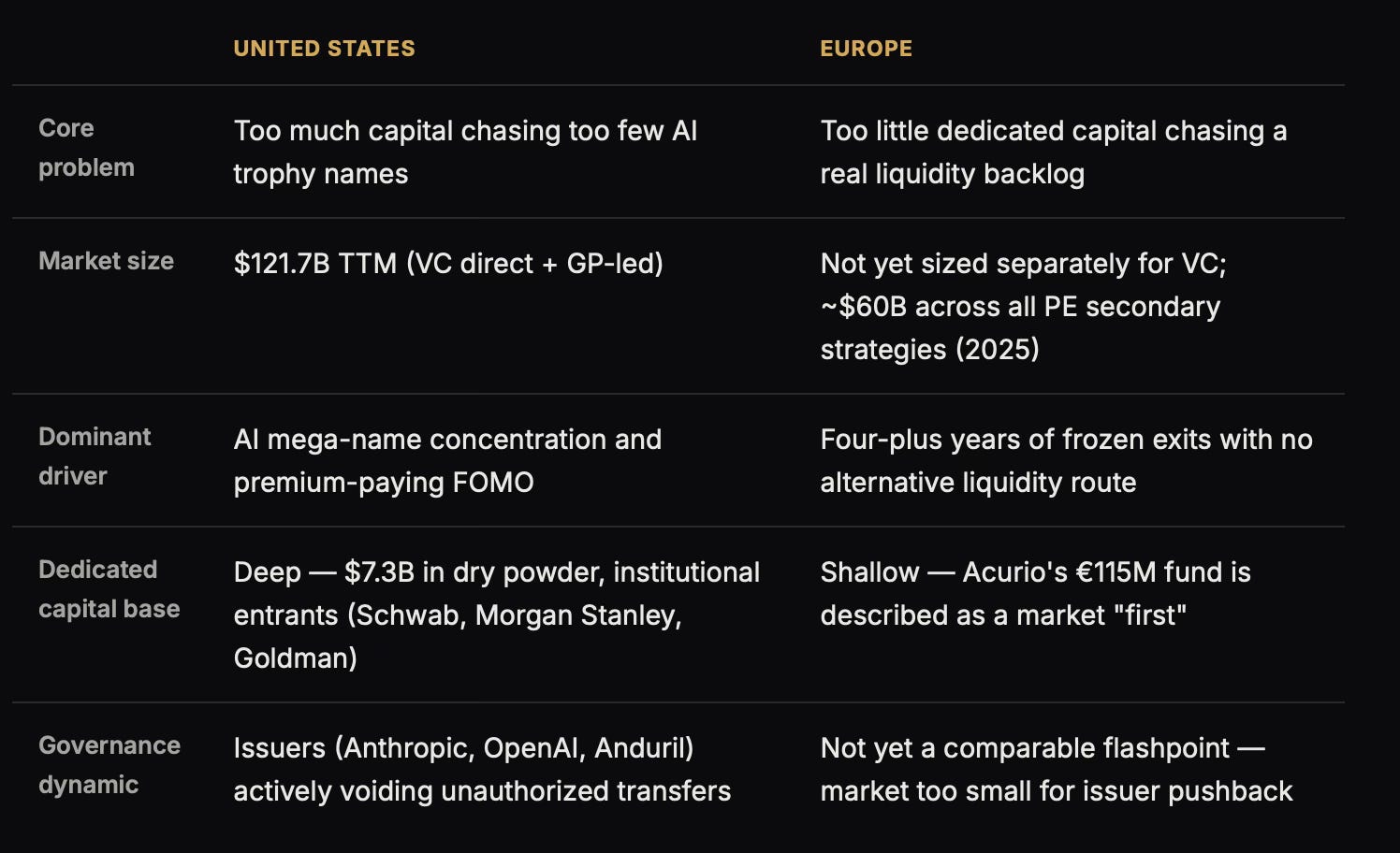
PitchBook’s latest US VC Secondary Market Watch, published this week, puts the trailing-12-month value of the market at $121.7 billion, with direct secondaries alone growing from an annualized $50 billion in Q4 2024 to $107.1 billion in Q2 2026. On paper, that’s a maturing asset class. Look at where the volume actually sits, and a different picture emerges.
On Hiive, the top five traded startups accounted for 50.3% of secondary value in Q2 2026, and the top 20 for 86%. Caplight’s data shows a similar pattern over the trailing year, with its top five names representing 42% of volume. AI is the common thread: the sector captured 40.8% of capital raised for secondary SPVs on Sydecar in Q2, and Caplight attributes 90.9% of its annualized volume to data, AI, or companies that recently closed a primary or secondary round. On EquityZen, 62% of AI transactions in Q2 traded above the company’s last primary round, buyers paying a premium simply to hold the name.
A market where five companies define half of all trading volume isn’t diversifying capital across a portfolio, it’s making a concentrated bet on AI’s biggest logos.
That’s a meaningfully different market than the one Secondary Scoop covers on the PE side, where GP-led continuation vehicles and LP portfolio sales function as routine liquidity and portfolio management tools spread across dozens of underlying assets. In venture, secondary demand is currently a proxy for a handful of pre-IPO AI and space bets: OpenAI, Anthropic, and, until recently, SpaceX. PitchBook’s own analysts frame the resulting concentration as a natural, non-distressed feature of a top-heavy market rather than a warning sign, and expect it to ease only modestly once distributions pick up and more public comparables exist. That’s their read, worth flagging as an interpretation rather than a settled outcome, since a “truly broad” venture secondary market, by the firm’s own account, is still likely years away.
Issuers are pushing back
Concentration around a small set of trophy names has produced a second, related story: startups reasserting control over who ends up on their cap tables. In Q2, Anthropic published a list of firms it said were not authorized to trade its shares and stated that unapproved transfers would not be recognized on its books and records. Investors holding indirect exposure through SPVs briefly worried their positions had been nullified. By mid-July, seven of the eight named firms had been removed from that list, with one remaining.
Anthropic isn’t alone. OpenAI has separately stated that equity transfers made without its written consent are void, and Anduril Industries has warned prospective buyers on its investor relations page that unauthorized offers to invest are very likely fraudulent. Board-approval requirements, rights of first refusal, and co-sale agreements are becoming standard practice at the handful of companies secondary investors most want exposure to — which, again, traces back to the same concentration problem: when demand pools around a few names, those companies gain the leverage to dictate terms.
WHAT’S A SINGLE-LAYER SPV?
Most indirect secondary exposure to a hot startup runs through a special purpose vehicle. In a single-layer structure, the SPV itself sits directly on the company’s cap table, meaning it’s the only entity that needs the issuer’s board approval. Everything above that layer (the investors who bought into the SPV) can transfer more freely, which is exactly the flexibility issuers are now scrutinizing more closely. Year-to-date, single-layer SPVs have surpassed direct-to-cap-table trades in value on Caplight, and ROFR exercise rates, while still lagging by a quarter in reporting, have fallen to 6.7% in Q1 2026, well below the 17.7% historical average, suggesting issuers are currently choosing to let more deals through than block them, even as they tighten who gets access in the first place.
The SPV structure has also become associated with a less flattering pattern: excessive fees and, in some cases, outright fraud. Several 2025 enforcement cases charged fund managers with claiming access to startups such as Anduril without actually owning the underlying shares. With SpaceX now public and its lockups beginning to expire, more cases of investors whose expected profits didn’t materialize are considered likely to surface over the coming months.
The infrastructure fight underneath it all
A less-discussed but structurally important thread: Nasdaq Private Market was awarded a patent in March for its automated clearing and settlement platform, then sued Hiive weeks later, alleging Hiive built a functionally similar product. NPM is seeking a jury trial, a permanent injunction, and damages that could cover the full history of transactions Hiive has processed on its competing platform.
This is not simply a dispute between two platforms. As institutional capital continues entering the space: Charles Schwab’s acquisition of Forge, Morgan Stanley’s acquisition of EquityZen, Goldman Sachs’s acquisition of Industry Ventures, the settlement rails underneath venture secondaries matter more with each passing quarter. A ruling in NPM’s favor would hand one company meaningful control over the plumbing the rest of the market depends on.
The European parallel: same immaturity, opposite cause
Zoom out to Europe and the concentration story doesn’t repeat, but the underlying “not yet a mature market” verdict does, for the inverse reason. Global secondary market volume (across private equity broadly, not venture alone) hit a record roughly $220 billion in 2025 according to William Blair’s 2026 Secondary Market Report, with Europe accounting for around $60 billion of that, the first year the survey tracked the region separately. That figure spans buyout and growth-equity secondaries as well as venture, so it isn’t directly comparable to PitchBook’s US VC-specific sizing; still, market participants describe fund-level VC secondaries in Europe specifically as a distinctly underdeveloped corner of that broader figure.
Where the US market suffers from too much capital chasing too few AI trophy names, Europe’s problem is closer to the opposite: too little dedicated capital chasing a genuine liquidity backlog. European VC funds have faced roughly four consecutive years of frozen exits, leaving fund managers without a viable path to return capital even where portfolios are performing. Until recently, the buyers stepping in to fill that gap have mostly been the same large US-based secondary specialists active everywhere else, Ardian, Blackstone Strategic Partners, Lexington Partners, HarbourVest, Goldman Sachs, rather than dedicated regional players.
That’s starting to shift, in small steps. Bilbao-based Acurio Ventures closed its Acurio Secondaries I FCR fund at €115 million in July, above its €100 million target, describing itself as the first dedicated European buyer of discounted stakes in mature venture funds. Its focus, deals under €20 million in fund-level secondaries, targets exactly the segment larger US managers tend to skip. Elsewhere, smaller dedicated vehicles like Nordic Secondary Fund (active since 2018) and Siena, which closed a €50 million second fund in September 2025, are buying direct startup stakes to provide liquidity to founders and early employees across the Nordics and Central and Eastern Europe. None of this yet amounts to a broad market, by their own description, these remain proof-of-concept vehicles in a nascent segment.