


UBS is not a secondaries firm, but it touches the market from three sides. It is the world’s largest wealth manager, with nearly USD 5 trillion of invested assets in Global Wealth Management. Private banks have become one of the main channels secondaries managers raise money from, through evergreen and semi-liquid vehicles. Through Unified Global Alternatives, UBS decides which alternatives products reach those clients, which makes it a gatekeeper for managers competing for shelf space. Its investment bank sits on the deal side: UBS is advising Lightspeed on Project Mercury, the OpenAI-anchored venture continuation vehicle led by Coller Capital. That is why a quarter dominated by Swiss capital rules still carries signals for secondaries buyers, sellers and fundraisers.
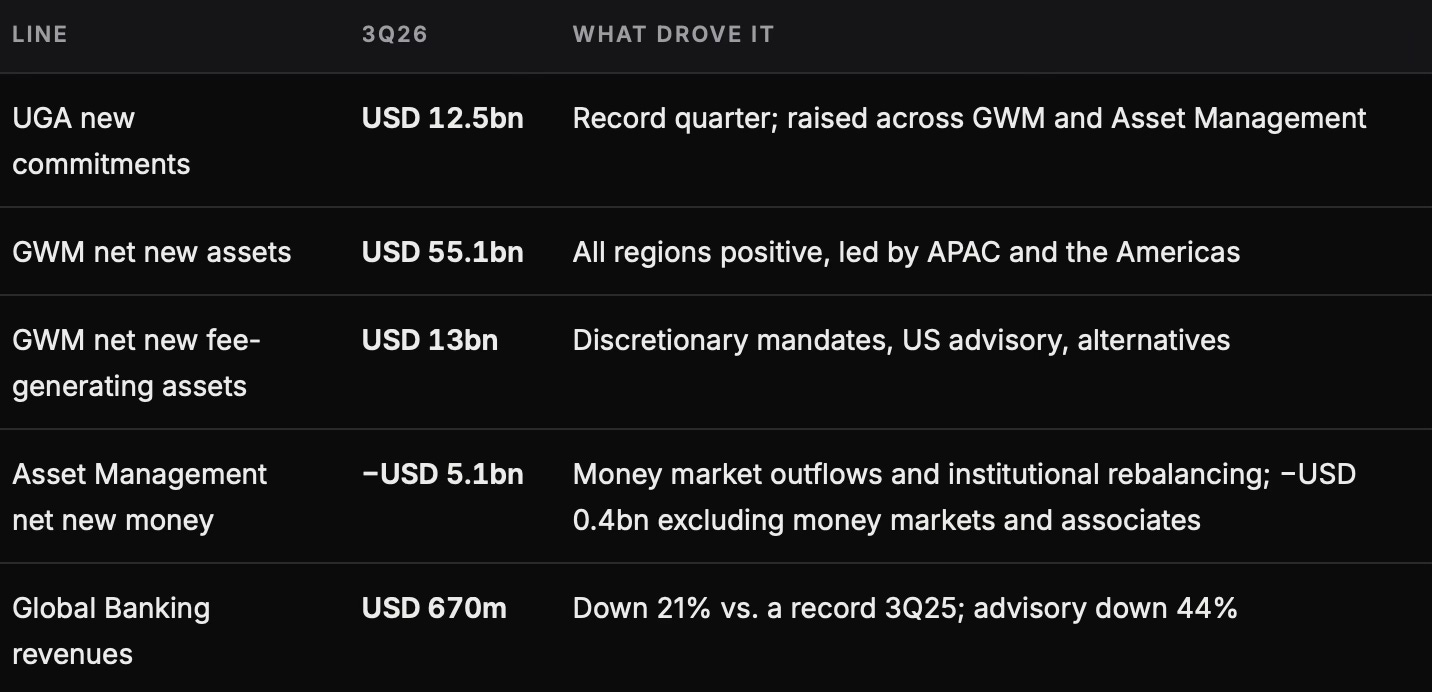
UBS reported 3Q26 net profit of USD 2.7bn and underlying pre-tax profit of USD 4.1bn, up 14% year on year. Most of the call was about Swiss capital rules. The figure that matters for private markets sat lower down: Unified Global Alternatives (UGA), the alternatives platform UBS runs across Global Wealth Management and Asset Management, took a record USD 12.5bn of new commitments in the quarter, bringing invested assets to USD 371bn.
Group CEO Sergio Ermotti flagged it in his opening remarks, and CFO Todd Tuckner framed it as proof of the bank’s model.
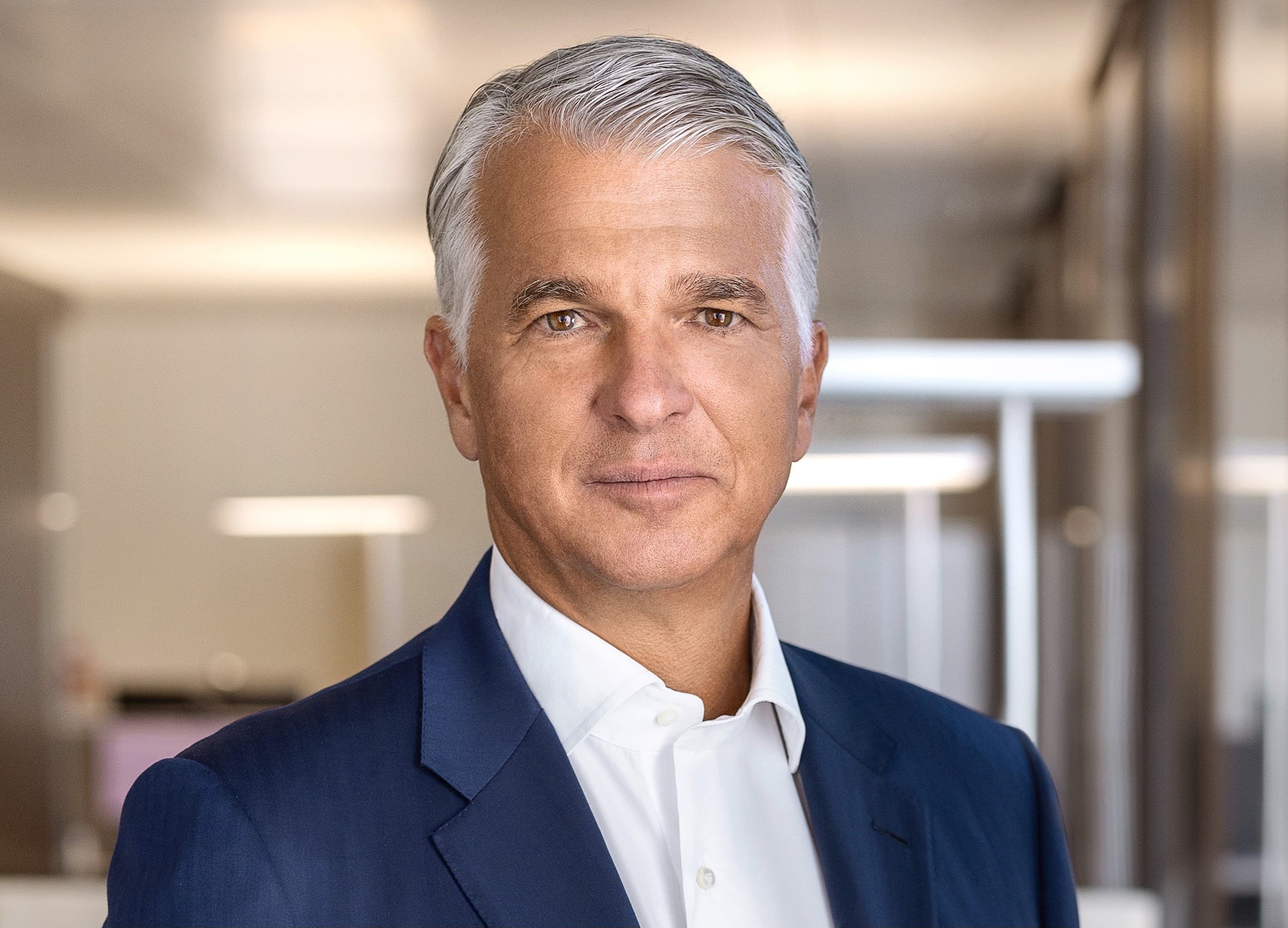
“Within UGA, we attracted a record 12.5 billion of quarterly new commitments across GWM and asset management, bringing invested assets to 371 billion and demonstrating the strength of our integrated distribution model.”
Todd Tuckner, Group CFO, UBS 3Q26 earnings call
The record came in a quarter when Asset Management posted net outflows of USD 5.1bn. Tuckner attributed those to “money market outflows and institutional portfolio rebalancing following the recent completion of our custody platform consolidation,” and said they were partly offset by positive flows into ETFs, SMAs and UGA. Excluding money market flows and associates, outflows were USD 0.4bn. In other words, the cash leaving UBS was not the cash going into alternatives.
The wealth side confirms the direction. GWM added USD 13bn of net new fee-generating assets in the quarter, with Tuckner citing momentum across “MyWay discretionary mandates, U.S. advisory, and alternatives.”
Source: UBS 3Q26 media release and earnings call, 28 October 2026.
WHAT UBS DOES NOT DISCLOSE
UBS does not break UGA down by strategy, so there is no public figure for how much of the USD 12.5bn went to secondaries versus private credit, buyout, hedge funds or real assets. No analyst asked on the call. This piece makes no claim about the secondaries share.
Why secondaries managers are watching the shelf
Private banks are now one of the main channels secondaries managers raise from, mostly through evergreen and semi-liquid vehicles. Evercore’s H1 2026 review found that 53% of secondary buyers operate an evergreen vehicle, and that evergreen and retail capital added around USD 40bn to the LP-led buyer universe over the prior twelve months.
We counted eight European managers with evergreen secondaries exposure for wealth clients when ICG and Amundi launched their evergreen LP secondaries fund earlier this month. Stableton, the Zug-based manager we profiled in September, built a USD 1bn book of VC direct secondaries largely through private-bank and online-broker distribution. A record quarter at UBS shows how much capital those channels can move, and how much leverage the bank holds over which products get placed in front of clients.
Pipeline one: liquidity events coming back as wealth
An analyst from Mediobanca pointed out that net new assets far exceeded net new fee-generating assets this quarter. Management said roughly USD 40bn of that gap came from IPOs and other liquidity events.
“The scale of IPO activity globally this year, including major U.S. listings and strong issuance across Asia, is creating significant opportunities, you know, to deepen client relationships and capture these wealth flows over time.”
UBS management, analyst Q&A, 3Q26 earnings call
Management added that about 10% of AUM, roughly USD 500bn, sits in custody or non-mandated assets, and described the total as “a lot of dry powder.” Ermotti made the same point from the investment bank’s side, describing how “IPOs, disposal of stakes, hedging of stakes” running through the bank are “critical elements in helping us to gather assets.”
For secondaries, this closes a loop. Exits and stake sales create liquid wealth, and part of it gets recycled into private markets through platforms like UGA. UBS sits on both ends. It is advising Lightspeed on Project Mercury, the roughly USD 600m process that moves stakes in OpenAI and four other companies into a continuation fund and adds a new commitment to Anthropic, with Coller Capital as lead buyer, as Bloomberg reported in August. The same bank then captures the wealth those exits produce.
Pipeline two: a possible opening for Chinese wealth
The most forward-looking private-markets comment came from a Morgan Stanley question about recent Chinese regulatory changes.
“We view the changes as offering a strategic upside in the wealth business, considering that we see there the prospect of a formal pathway for Chinese individuals to invest onshore wealth and offshore direct and private market opportunities.”
UBS management, analyst Q&A, 3Q26 earnings call
CHINA’S OFFSHORE DIRECT INVESTMENT RULES
Management said the final consultation paper on the offshore direct investment (ODI) changes was issued the week before the call. The rules are still subject to implementation and consultation. UBS said there are key questions on scope and application and that it is too early to quantify the impact, while calling the changes “strategically promising” for its business.
If the pathway opens, it would give global private markets managers a new source of capital at a time when sovereign and institutional Asian LPs, including GIC and KIC, have been exploring sales of fund interests. The difference is that this capital would come through wealth platforms, where UBS’s APAC business already grew net new assets at a 9% annualized rate this quarter.
The other side of the bank had a soft quarter
The advisory business did not share in the strength. Global Banking revenues fell 21% to USD 670m against a record prior-year quarter. Tuckner said advisory revenues declined 44%, “also reflecting transaction timing,” in a fee pool that “remains concentrated in mega cap transactions, where balance sheet commitment plays a more prominent role.” Leveraged capital markets were lower on “lower sponsor activity.” He said client engagement and origination remain strong and guided to sequential growth in Global Banking revenues in the fourth quarter, assuming constructive markets.
The tone on the fourth quarter was cautious. Asked about client engagement, management listed “rising correlations, deterioration in credit conditions, higher bond yields, and renewed inflation concerns” as factors “leading to more defensive positioning among our clients.” Defensive wealth clients are not obviously the ones adding to private markets allocations, so the fourth-quarter UGA number will be a useful test.