


On Lazard’s third-quarter call, Peter Orszag, CEO and Chairman, was asked whether higher rates are holding back dealmaking. For strategic acquirers, his answer was no: scale in technology, supply-chain security and a permissive U.S. regulatory window still outweigh a few dozen basis points at the long end. Sponsors are a different story.
Orszag described sponsor M&A as stuck between two forces. Portfolio company owners are still holding out for better valuations, and higher rates make that gap harder to close. On the other side, LPs keep pushing for cash and liquidity events. Until one force wins, sponsor exits stay thin. He then made the point that matters for this market:
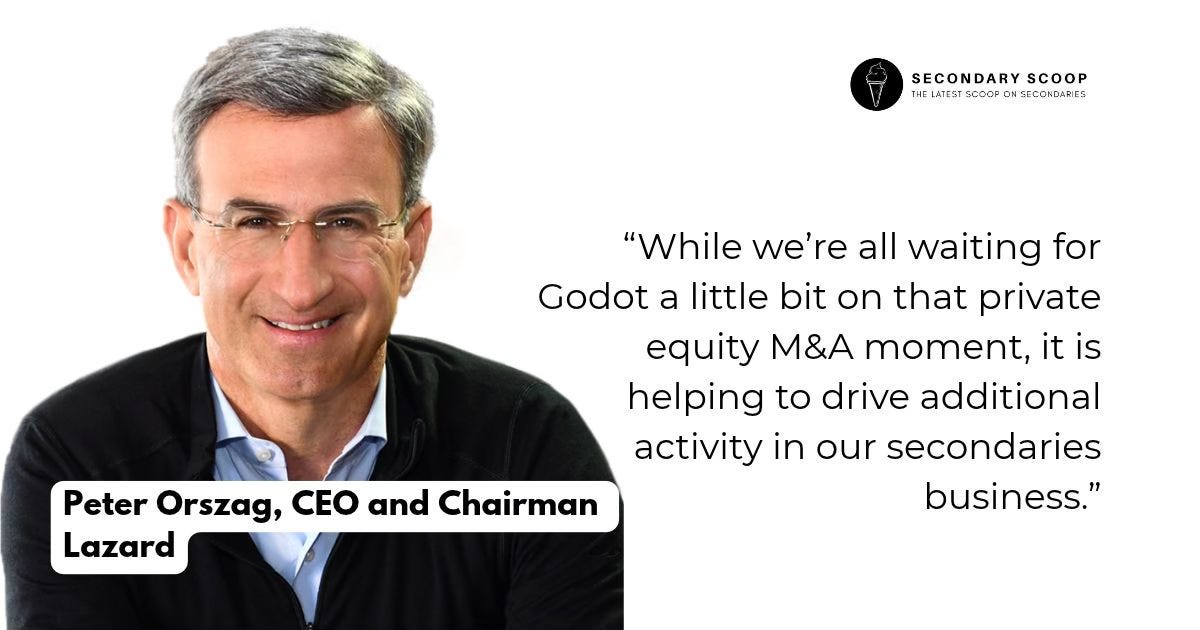
“While we’re all waiting for Godot a little bit on that private equity M&A moment, it is helping to drive additional activity in our secondaries business.”
Peter Orszag, CEO and Chairman, Lazard, Q3 2026 earnings call
That is the strategic logic of Lazard CL in a single sentence. The same valuation gap that keeps sponsor sales on hold sends GPs toward continuation vehicles and LPs toward portfolio sales. Lazard has built a franchise that earns fees on both sides of that seesaw. If sponsor M&A recovers, the M&A bankers benefit. If it does not, the secondaries team does.
Orszag said the effect is sharpest in software. There, he said, the gap between owners’ expectations and what buyers will pay has widened more than elsewhere over the past year, and the rise in rates makes it worse. Software-heavy buyout portfolios are exactly where we would expect GP-led supply to keep building into 2027.
Lazard CL: what changed since April
The Campbell Lutyens acquisition was announced on April 30. The Q3 materials add several new data points to the restated deal terms:
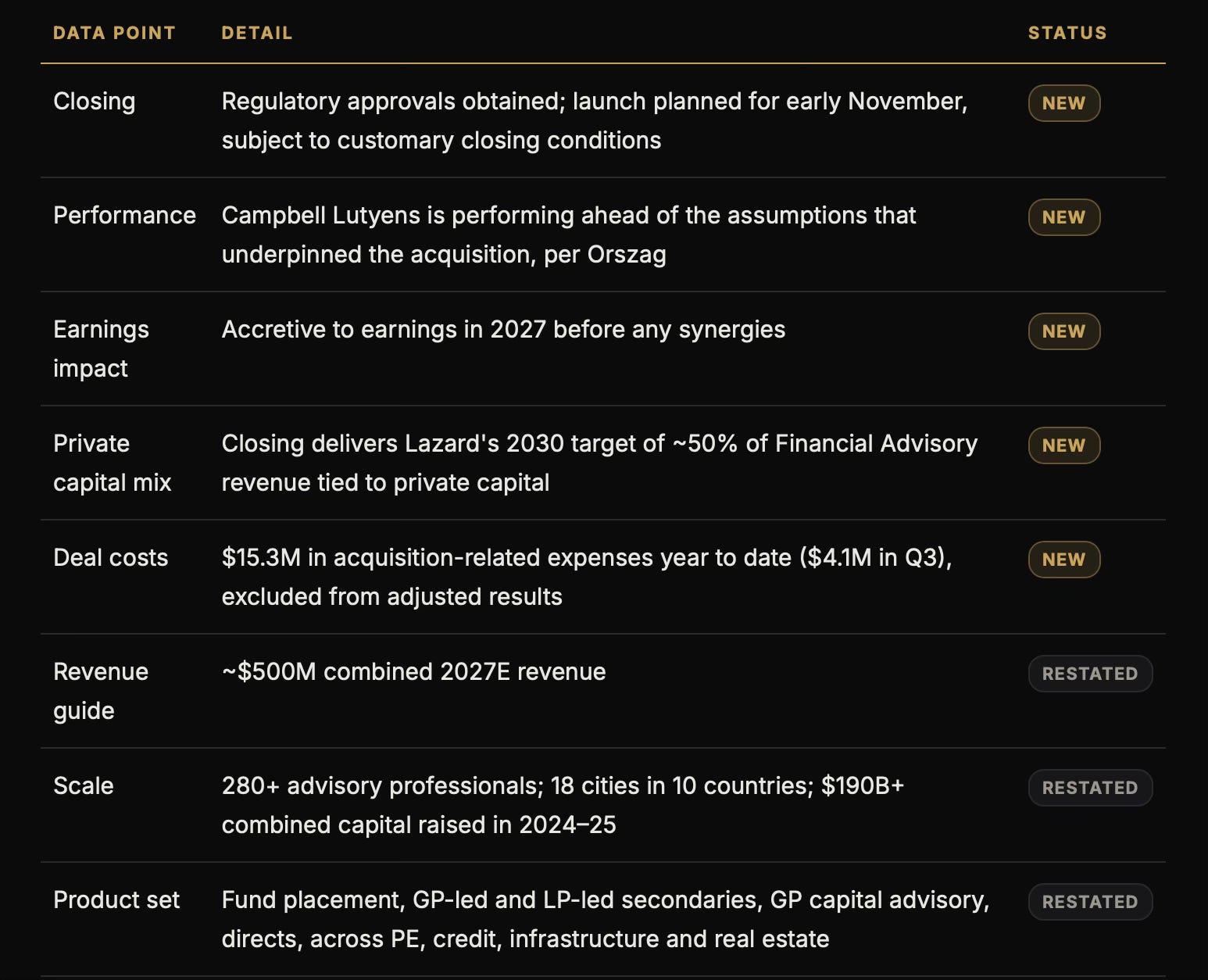
The $190B+ figure is capital raised through fund placement. It is not secondaries transaction volume and should not be compared with secondary volume league tables.
Accretion before synergies matters because synergies are where the deal thesis lives. On costs, Orszag pointed to early savings in real estate, vendors and IT. On revenue, he described referrals running in both directions: from Lazard CL to the M&A bankers, and from Lazard’s private capital coverage into fundraising mandates.
“So there is a flywheel or circularity there that’s very positive.”
Peter Orszag, Q3 2026 earnings call
He also gave a benchmark. Campbell Lutyens previously ran a joint venture with another investment bank that produced what Orszag called a notable level of M&A referrals. Lazard did not include those referrals in its deal underwriting. It nonetheless expects to “at least match and in all likelihood significantly beat that level of M&A referrals.” In practice, this is upside that has been left out of the base case. It does not appear in the ~$500M guide.
Private capital is now half the advisory story
Asked about large-cap M&A, Orszag used two numbers to show that Lazard is now covering both large-cap strategic deals and private capital. Its year-to-date league table position is its best in over a decade, and private capital is taking a record share of advisory revenue:
“In the third quarter, our share of revenue coming from private capital is at an all-time high.”
Peter Orszag, Q3 2026 earnings call
Once Campbell Lutyens closes, that share moves to roughly half of Financial Advisory revenue. Lazard set that level as a 2030 goal and will reach it about four years early. For a firm built on large-cap, board-level M&A, this changes its identity. Private capital, including secondaries, now accounts for half of its advisory business.
The headline numbers support the narrative but do not prove it yet. Financial Advisory adjusted net revenue was a Q3 record at $465M, up 10% year over year, but the nine-month total is down 1% at $1,266M. Firm-wide, the adjusted compensation ratio stayed at 69.9%, well above the 60% target. Q3 advisory revenue was split roughly 61% M&A and 39% non-M&A, per the call. Lazard says its probability-weighted 2027 pipeline is slightly more than double where its 2026 pipeline stood a year ago.
Q3 PRIVATE CAPITAL ADVISORY MANDATES
Continuation funds: Blue Sea Capital, Exponent Private Equity, M-One Capital
Fund closings: Kingswood Capital Management Fund IV and Small Cap Fund I; LLCP Lower Middle Market Fund IV; Princeton Equity Group Fund III; TruArc Fund V
All three continuation fund mandates are lower-middle-market and mid-market sponsors, which is the segment where GP-led volume has been broadening. Per Lazard’s Q3 earnings release.
What we’re watching
Three things will show whether the hedge works.
Segment disclosure. Lazard currently reports no standalone secondaries revenue, no secondaries transaction volume and no separate Campbell Lutyens figures. Lazard CL becomes the firm’s third global business unit at closing. Whether it is reported as a separate segment with its own revenue line will determine whether investors can check the ~$500M guide and the referral thesis.
Integration and retention. Secondaries advisory depends on a small number of senior bankers who move between firms. “Ahead of plan” before closing is encouraging. The real test is the first full year inside a listed, compensation-ratio-focused parent. Separately, Lazard is reviewing its deferral policy and may shift more pay into cash.
The Godot timing. If sponsor M&A reopens in 2027, as Lazard’s pipeline suggests it might, some GP-led supply will shift back to traditional exits. Lazard’s bet is that it does not need to predict when that happens. That holds only if both desks are fully staffed when it does.
BEYOND THE ADVISORY DESK
Lazard’s asset management arm, which is separate from Lazard CL, disclosed a controlling stake in Elaia Partners to extend its exposure to venture capital and private markets. It reported $284B in AUM and $5.1B in nine-month net inflows. This is adjacent to secondaries rather than part of the secondaries business.