


Noveon Capital kicked off the week by announcing its launch, with a distinction few new secondaries firms can claim: it has already made an investment. The press release says it “has completed three secondary transactions in 2026, investing from its own balance sheet alongside co-investors.” These were a co-lead investment in a GP-led continuation vehicle and two purchases of LP interests in China-focused funds. Noveon hasn’t named the deals, their sizes or its co-investors.

Sung Ko, founder and managing partner, spent 11 years at Carlyle in New York, Washington, D.C. and Hong Kong, most recently as a managing director. Bloomberg describes his role there as fundraising and investor relations. Before Carlyle he worked at BlackRock and HSBC. Co-founder and managing partner Chris Shen spent 12 years investing in Asian private companies at Warburg Pincus and Bain Capital, after starting in Morgan Stanley’s Hong Kong investment banking division. Noveon Capital Limited is licensed by Hong Kong’s Securities and Futures Commission for asset management and serves professional investors only.
“Asia has built a deep bench of private companies, but many sit in funds that are running out of time as holding periods lengthen.”
Sung Ko, founder and managing partner, Noveon Capital, launch press release
The firm will buy GP-led and LP-led secondaries, direct secondaries and structured solutions across Greater China, North Asia and Southeast Asia, and says it “pursues concentrated investments in private companies.” Ko told Bloomberg the firm has looked at more than 60 opportunities, representing about $17 billion of reported NAV. Ko’s LinkedIn launch post invites family offices and institutional investors to get in touch, so Noveon is raising capital now.
The gap Noveon is aiming at
The numbers behind Asian secondaries have been the same for years. A lot of capital is stuck and few buyers are dedicated to the region. Asia accounted for 2% of last year’s $226 billion in global secondaries volume, against 65% for North America and 29% for Europe, according to Evercore figures reported by Bloomberg.
Noveon’s release cites the more recent data. Asia-Pacific sponsors had closed $5.9 billion of GP-led deals by October, already matching all of 2025, with about $10.9 billion more in market (Campbell Lutyens). Funds focused on North America and Europe still made up 95% of LP-led volume in the first half, and interests with Asia and emerging-market exposure priced at discounts of 35% or more to NAV, against about 13% across all LP portfolios (Jefferies). The number of Asia-Pacific portfolio companies held for more than five years rose 18% in 2025 (Bain & Company).
Asian funds have also underperformed. The San Francisco Employees’ Retirement System’s Asia PE and VC funds returned an annualized 7.9% net over the past decade, against almost 15.5% in North America and 11.4% in Europe, according to Bloomberg. Ko’s reading is that the region doesn’t have a capital problem, it has an allocation problem:
“Diversification hasn’t delivered in Asia, where returns have been below those in North America. The key is to be selective and target the best assets.”
Sung Ko, speaking to Bloomberg
The problem is the lead, not the bid
Asia’s CV market isn’t held back by a lack of small cheques. It’s held back by a lack of lead investors. These are the buyers that set the price, negotiate terms with the GP and write the largest ticket. TR Capital founder Paul Robine has told Mergermarket he thinks only a handful of groups can make lead commitments of that size in Asia. In the same piece, Greenhill’s Asia Pacific head of private capital advisory, Lloyd Bradbury, said participation from Middle Eastern investors often seems necessary to get a large CV done.
That’s where the Gulf money comes in. According to Bloomberg, Abu Dhabi Investment Authority led a $770 million vehicle for CDH Investments in January, and Mubadala backed a roughly $1 billion Centurium Capital deal involving Luckin Coffee in September. Ko expects sovereign funds and family offices to drive a wave of deals over the next two years.
Noveon’s first CV was a co-lead, done alongside co-investors and paid from its balance sheet. That looks like the model: Noveon sources and structures the deal, and brings in co-investors alongside its own capital. The release says position sizes depend on “transaction structure and capital arrangements.” Ko put it more directly to Bloomberg:
“Our bet is I can get these deals, we can get access, others will want to join.”
Sung Ko, speaking to Bloomberg
That plays to the founders’ backgrounds. Ko spent a decade raising money from the kind of investors Noveon now wants as partners. Shen spent his career on the deal side in the region. The approach can work, but it puts more lead capacity in the hands of Noveon’s partners, not in Noveon itself.
A small group of specialists
Most secondaries capital deployed in Asia comes from global funds run by firms such as Coller EQT, HarbourVest, Pantheon, StepStone and Hamilton Lane. Only a small number of independent firms do Asia secondaries as their whole business:
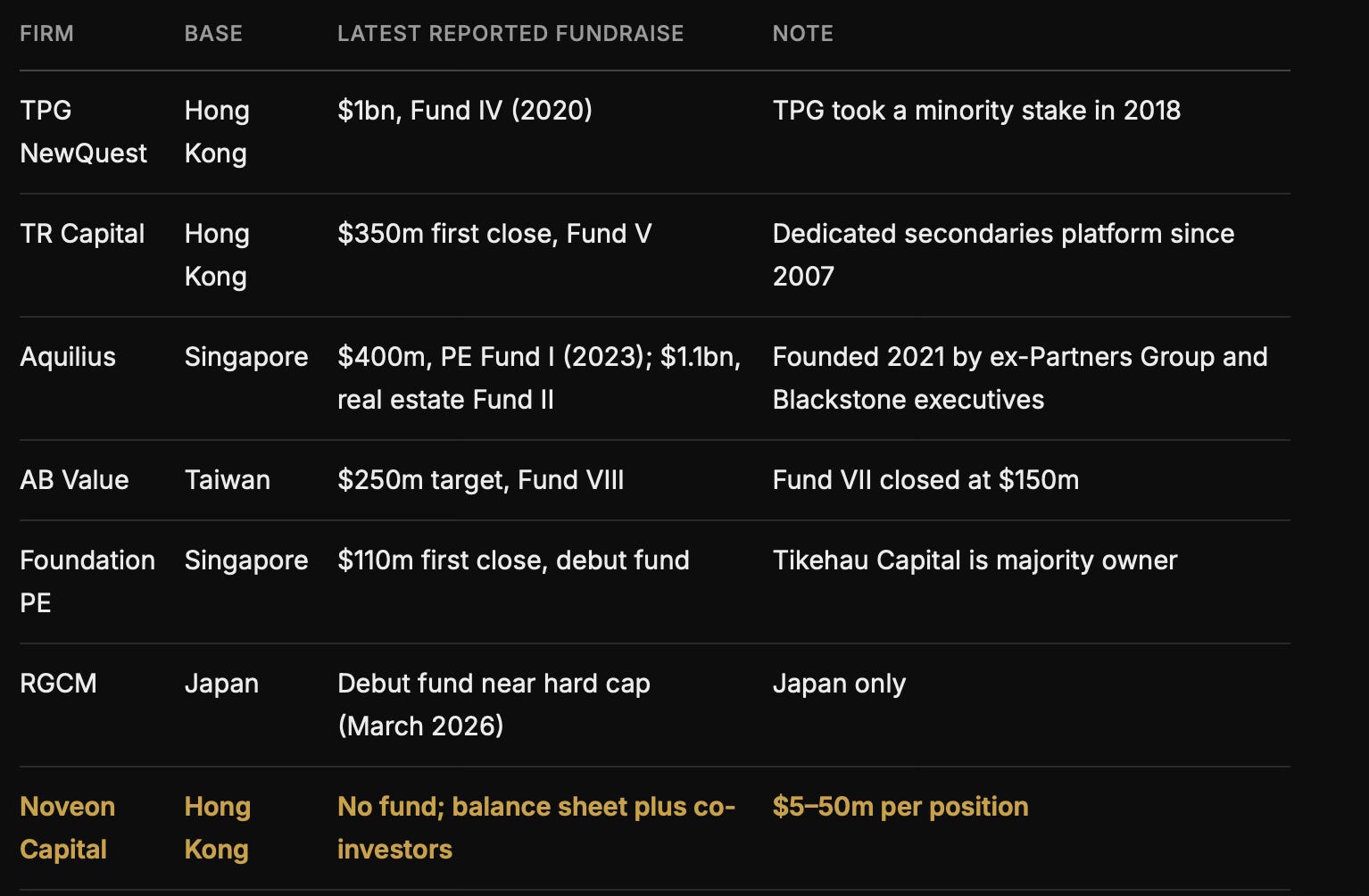
Sources: AVCJ, Mergermarket, IREI, PEI Secondaries Investor, Noveon. Figures are the most recent we could find publicly; some date back several years and current fund sizes may be larger. Not exhaustive.
On cheque size, Noveon’s closest peers are AB Value and Foundation, the mid-market and LP-led specialists, not TPG NewQuest. A new firm in this group adds bids. It adds lead capacity only to the extent that Noveon can bring co-investors like the Gulf funds and family offices it’s targeting into its deals in large amounts.
THE ONSHORE MARKET IS DIFFERENT
China is also building a large RMB secondaries market, mostly with state money. In March, Fujian launched a provincial S fund of more than RMB 4 billion, with China Life as the main backer, and Shanghai’s SIG has planned a RMB 10 billion vehicle. These funds mostly provide liquidity to onshore RMB funds. They rarely compete for the USD-denominated CV interests Noveon is targeting.
Is it about the discount?
Noveon gives two answers to that question. Its website, written for LPs, says the gap in secondaries capital “creates structurally mispriced opportunities to access high-quality assets at compelling entry prices.” The press release adds:
“In secondaries, a discount alone is not an investment thesis. We start with the company we want to own, then work back to the transaction.”
Chris Shen, co-founder and managing partner, Noveon Capital, launch press release
Buying a strong company at a discount is the point. Still, the firm stresses discounts when it’s talking to LPs and company quality when it’s talking to GPs. In Shen’s words, sellers want buyers “who understand those businesses and can close with certainty.”
Noveon is also building NoveonOS, an AI workflow platform for analyzing investment documents, evaluating companies and monitoring portfolios. Ko leads its development. The release says it is meant to “complement” the team’s underwriting, not replace it.
PitchBook has reported more detail on the early deals than Noveon disclosed. It describes the three trades as GP-led deals in China bought at 40% to 50% discounts to the GP’s mark, including an LP interest in GSR Ventures’ Fund IV, which Ko reportedly said is 92% invested in Xiaohongshu (RedNote). Noveon’s own description is different: one GP-led deal and two LP purchases. The release gives no pricing and no fund names.
Asia's secondaries shortfall reads less like a shortage of capital than a shortage of buyers willing to set a price. A new firm that must assemble co-investors for each ticket adds competition but not anchor capacity, and the lead is what fixes a valuation. Two per cent of global volume is a thin base for that role.