


Partners Group's H1 2026 earnings call, hosted from the firm's London office for a room of invited investors and analysts, read on its face like a routine private-markets update: a record first half for fundraising, resilient margins, a long-serving CEO handing the wheel to a new team. Buried in the prepared remarks and the analyst Q&A, though, were three things secondaries watchers should actually care about: quiet confirmation that Partners Group's own secondaries platform is pulling real financial weight, a leverage flag inside its flagship evergreen fund that a curious analyst pressed hard on, and a hard number on how its assets are pricing relative to their marks.
The scoreboard
Start with the headline print, because it sets the stage for everything else. Partners Group raised $16 billion of new capital in H1 2026, up 31% year over year and, per CEO Dave Layton, the best first half the firm has had in 30 years of raising private capital. Full-year guidance was reaffirmed at $26–32 billion. Since 2023, the firm has raised $80 billion while the broader private-markets fundraising market has contracted roughly 15%, meaning Partners Group has been taking real share in a down market, gaining about 50% in relative terms over that stretch.
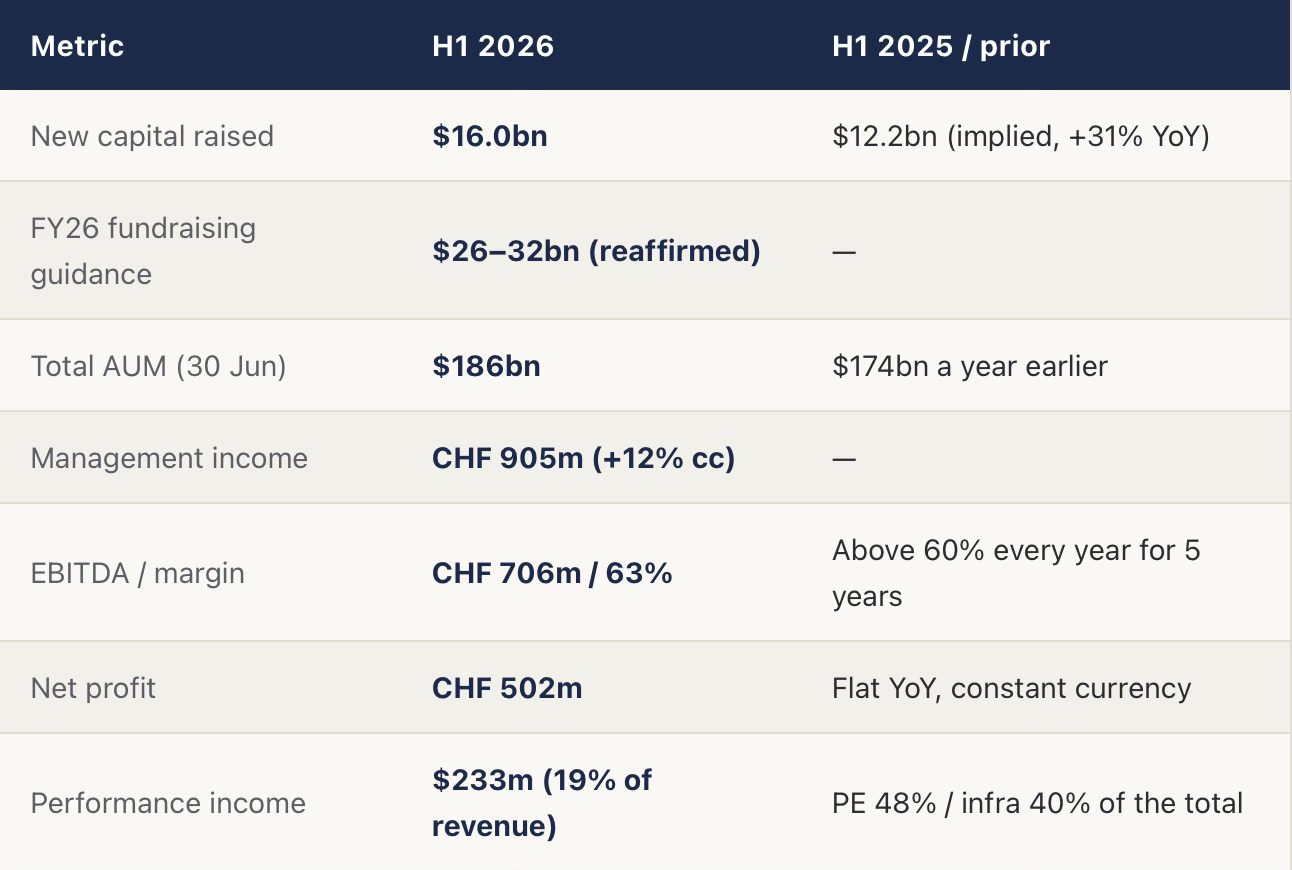
Total AUM stood at $186 billion at quarter-end, up from $174 billion a year earlier, still tracking toward the firm’s 2033 target of $450 billion-plus. Management income, the recurring, fee-based part of the business that investors reward with a premium multiple, grew 12% at constant currency to CHF 905 million, representing 81% of total revenue in the half. The overall EBITDA margin held at 63%, in line with a bandwidth the firm has kept above 60% for five straight years. Net profit came in at CHF 502 million, flat year over year on a constant-currency basis, translating to a 55% return on equity.
One wrinkle worth flagging for anyone modeling the stock: another curious attendee pointed out that the recurring fee margin actually fell to roughly 109 basis points in H1, versus the 63% headline EBITDA margin that includes them. Management’s explanation was a mix effect, not a business problem: infrastructure and private credit fundraising ran hot relative to private equity in the half, and mix shifts the blended margin around within its historical 1.18%–1.33% management-income-margin band. A large new flagship PE fundraise is coming, which management says will shift the mix back.
The quiet secondaries flex
Here’s the detail that will matter to us, and it came almost in passing. On the call, CFO Joris said plainly: “Thanks to the successful final closes of our direct infrastructure programme and private equity secondaries programme in H1, late management fees, which is part of other operating income, came in very strongly and contributed positively to our management income growth.”
That’s a direct, on-the-record confirmation that the eighth vintage of Partners Group’s private equity secondaries program, which closed on April 17 with more than $9 billion of total commitments, as we covered in our August 23 deep dive on the firm’s four-vertical secondaries platform, is now showing up in the P&L, not just in the press release. Late management fees are a real, cash-generative line item, and Partners Group is telling investors its secondaries franchise is one of the two named drivers behind H1’s management-income beat (the other being the record infrastructure close, itself up roughly 50% on its predecessor).
It’s a small sentence in a 25-page transcript, but it’s the kind of quiet validation that matters more than another glossy program-launch press release: the secondaries business isn’t just raising bigger funds every few years, it’s now a recurring, countable contributor to group financial performance in the same breath as infrastructure, long the firm’s most celebrated growth engine.
The evergreen leverage flag
The sharpest exchange of the call came from Ian White at Autonomous, who pushed on something most of the room seemed to want asked: Partners Group’s own PGPE, its flagship evergreen, semi-liquid private equity vehicle, disclosed in its own 1H update that trailing 12-month EBITDA growth across its portfolio companies has slowed to under 5%, while net debt to EBITDA has climbed from roughly 5x to nearly 7x over the past two years. White asked, bluntly, whether that was representative of the broader private equity industry, why leverage had risen so much, and whether payment-in-kind debt structures were part of the story.
“PGPE has an elevated exposure to vintages 2020, 2021, 2022, driven by the distributions that have to be reinvested in such a vehicle. As such, the broader private equity platform is much more diversified across vintages.”
Dave Layton, CEO, responding to the PGPE leverage question
That’s a real structural point, and worth sitting with. In an evergreen fund, capital returned from realizations doesn’t go back to LPs the way it would in a closed-end vehicle, it gets recycled straight back into the same portfolio. PGPE happened to be receiving heavy distribution flows during the 2020–2022 boom years, so those vintages now make up an outsized share of the fund at exactly the moment aging, boom-era buyouts are the asset class everyone, PitchBook included, in the zombie-fund research we wrote up on August 18, is watching most closely for leverage and growth stress. Notably, the payment-in-kind question was never directly answered.
This is exactly the kind of data point the CV-pricing debate in our zombie-problem piece was missing: not a hypothetical about what an aging, over-levered vintage cohort might look like, but Partners Group’s own flagship retail-facing evergreen fund disclosing it live, in public, on an earnings call.
The redemption tell: 10% above marks
The second half of that exchange is the more secondaries-relevant one. BNP Paribas’s Arnaud asked whether the roughly 5%-per-quarter evergreen redemption rate was putting pressure on marks, the fear being that heavy redemptions create an incentive to keep valuations low. Portfolio Solutions co-head Roberto Cagnati, who is stepping into a co-CEO role in January, pushed back hard, stressing that marking is done under IFRS as an independent process, unconnected to redemption flows.

“Typically, there will be one price for the same asset across the platform. I think it’s true also for the last six months that, on average, we sold our assets at about 10% above our marks.”
Roberto Cagnati, incoming co-CEO
Ten percent above marks, sustained over six months, is a genuinely strong data point, it’s the same directional signal our August 18 piece found in Jefferies’ and Campbell Lutyens’ H1 2026 continuation-vehicle pricing data, where single-asset CVs were pricing at or above NAV while multi-asset baskets lagged. Read generously, it says the secondary market is pricing these evergreen positions fine and it’s the official marks that are conservative. Read more skeptically, and management essentially conceded this point unprompted, some of that premium may reflect selection: managers naturally sell their strongest, most saleable assets first, and “the early investors, they made five times,” as one executive put it later in the call, describing exactly the kind of vintage that’s easiest to move at a premium.
On liquidity gates, management repeated guidance from its July AOM update rather than giving new numbers: gates on its more mature, private-equity-focused evergreen strategies are expected to persist for another 12 to 18 months, even as the broader evergreen platform, including new joint ventures, is still expected to add $20–30 billion of growth. Management declined to say how many funds are currently gated.
A $75 billion exit backlog
Performance income, the variable, exit-driven part of revenue, came in at $233 million in H1, or 19% of revenue, split roughly 48% private equity and 40% infrastructure, and driven mainly by direct-portfolio exits rather than fund-level realizations. Full-year guidance was trimmed to the low end of a 20–25% range, which one analyst noted was effectively a five-point cut versus where guidance stood a quarter earlier. Management’s explanation was timing, not deterioration: several sizable exits, including one large transaction close to being agreed, are more likely to close in early 2027 than in December.
That matters because of what management is holding out beyond this year: a $75 billion realizations pipeline currently being worked, which they expect to push performance income to 25–40% of revenue over the next three years and beyond. For a secondaries audience, that’s a supply signal worth logging, a firm with Partners Group’s demonstrated appetite for GP-led structures across all four of its secondaries verticals is sitting on a large, aging exit backlog at the exact moment exit markets remain, in its own words, “reasonable but not straightforward.” Some of that $75 billion will find its way to strategics and IPOs. Some of it, on recent form, will likely find its way into continuation vehicles instead.
The changing of the guard
The other headline from the call: Dave Layton, CEO for nearly eight years, is stepping into the newly created role of CIO and chair of the Global Investment Committee starting January 2027, a return, in effect, to the private equity investing seat he held before becoming co-CEO in 2019. Filling the CEO chair: a co-CEO structure, with Juri (who built out the firm’s credit business before running infrastructure and, most recently, serving as president) and Roberto Cagnati stepping in together.
The Cagnati appointment is the one worth underlining for this audience. As we noted in our August 23 profile, he’s the executive most directly credited with building Partners Group’s mandate, evergreen and structured-products franchise, the same evergreen business now at the center of the leverage and redemption questions above. Having the architect of that franchise now co-running the firm is either a vote of confidence that evergreens remain core to the 2033 growth plan, or an acknowledgment that the franchise needs its builder’s direct attention at the top table. Both readings are plausible, and the call gave ammunition for either.
What we’re watching next
Whether the private equity secondaries programme’s late-fee contribution becomes a recurring disclosure line, or was a one-time H1 close effect that fades from the numbers by year-end.
Any update on PGPE’s leverage trajectory and the unanswered payment-in-kind question, management pointed to “next March” for a fuller AI/data-driven portfolio update, which may be the next natural moment for more disclosure.
Whether the 5%-per-quarter evergreen redemption rate and the 10%-above-marks pricing hold up as gates persist over the next 12–18 months, or whether that spread compresses as more mature vintages exit.
How much of the $75 billion realizations pipeline lands via strategics and IPOs versus GP-led secondary structures once it starts closing in 2027.