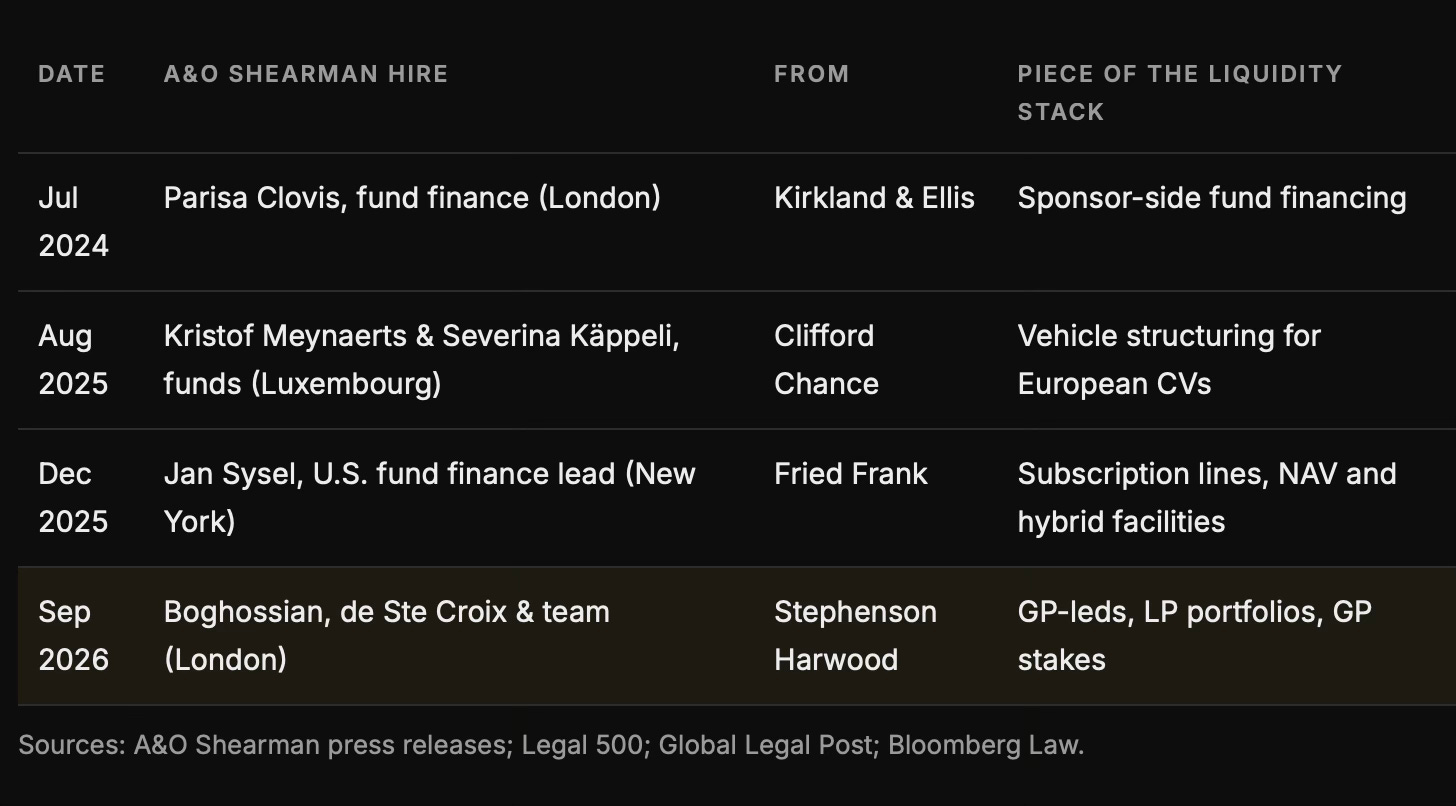
A&O Shearman, the global law firm formed in 2024 from the merger of Allen & Overy and Shearman & Sterling, announced today that Gabriel Boghossian and Sarah de Ste Croix will join as global co-heads of secondaries, together with “their full team” in London. The release doesn’t name their current firm. Public records do: both built their practices at Stephenson Harwood, where Boghossian led secondaries and de Ste Croix led private funds. Stephenson Harwood marketed the unit as the only team in the market with two Chambers Band 1-ranked secondaries partners, with 15 secondaries professionals as of 2025.
To understand why a firm with roughly 4,000 lawyers acquired a practice instead of growing one, it helps to start with what secondaries lawyers actually do.
The quiet seat at the table
Investment banks and advisors, Jefferies, Evercore, PJT Park Hill, Lazard, get most of the attention in secondaries. They run the process, find the buyers and set the price. Law firms turn an agreed price into a transaction that can close and hold up afterward. In an LP portfolio sale, that work is comparatively contained: a purchase and sale agreement, transfer consents from each underlying GP, and the mechanics of moving fund interests between owners. In a GP-led deal, the legal workload multiplies.
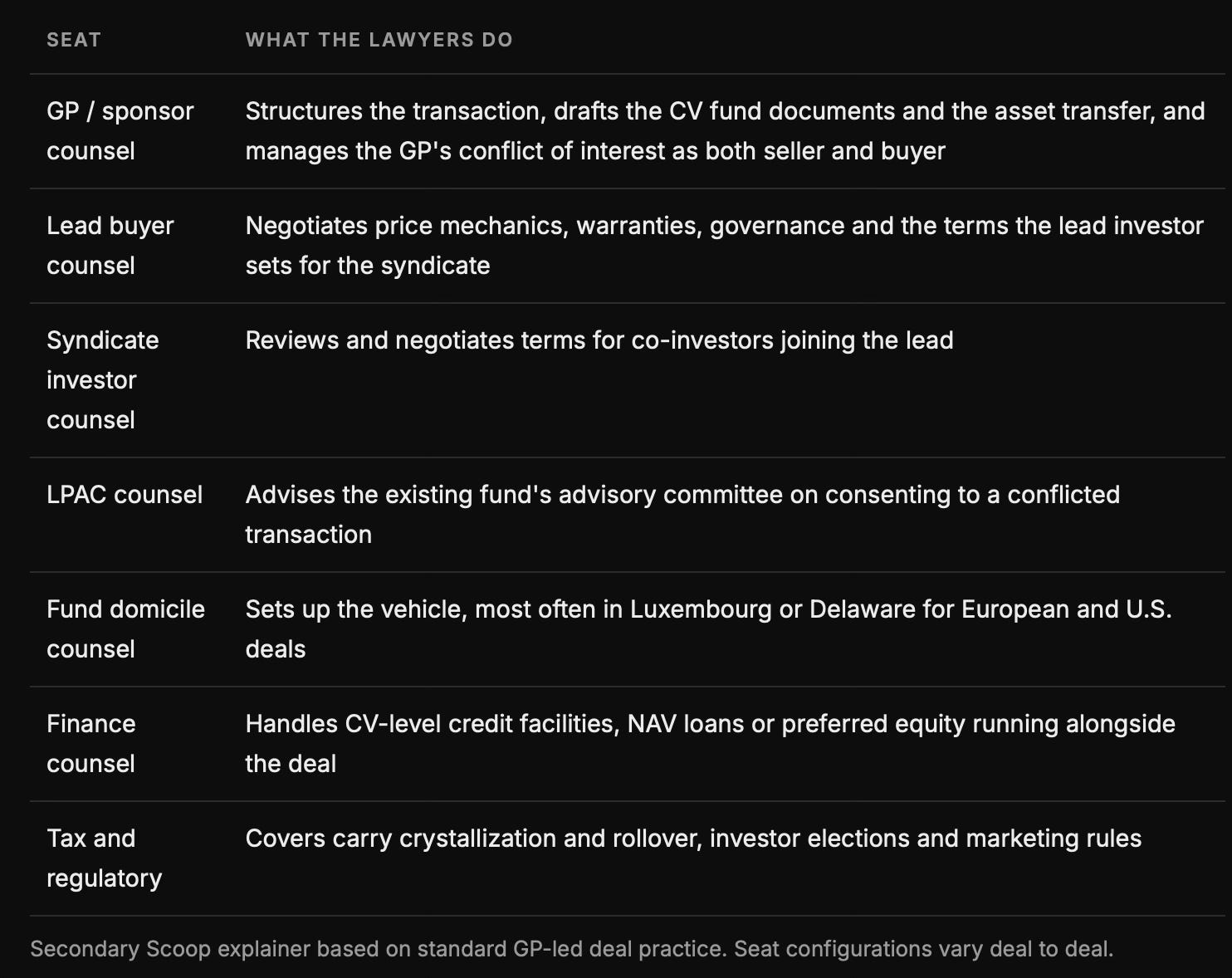
THE LEGAL SEATS IN A GP-LED CONTINUATION VEHICLE
A typical single- or multi-asset continuation vehicle can involve separate counsel for most of the parties below. Each seat is a distinct mandate, and the conflicts between them are the reason no one firm can hold them all on the same deal.
Two forces have raised the stakes for this work. First, GP-leds now make up most of the market. Jefferies’ July 2026 review put H1 GP-led volume at $62bn, or 53% of total volume, up 32% year over year. Bespoke, conflict-heavy deals command specialist teams and premium fees in a way standardized LP transfers don’t. Second, the GP’s conflict, selling an asset from one fund it manages to another fund it manages, puts the legal process at the center of whether LPs see the deal as fair. The drafting, the LPAC consent process and the election offered to existing LPs are where that fairness is either demonstrated or not.
Why buy rather than build
A&O Shearman already had most of the adjacent products. Its fund finance and liquidity solutions practice lists NAV facilities, GP and management fee lines, and secondary and continuation facilities. It had hired Jan Sysel from Fried Frank in December 2025 to lead U.S. fund finance and rebuilt its Luxembourg funds bench with two Clifford Chance lawyers in August 2025. What it lacked was the transactional core. Four features of the secondaries market explain why growing that core internally would have been slow and uncertain.
1. It is a repeat-player village
A relatively small group of lead buyers, placement advisors and sponsors does a large share of GP-led deals, and they choose counsel largely on track record with each other. Stephenson Harwood’s own marketing leans on this idea, describing a “secondaries village” that rewards a collaborative approach. A newly built team starts with no seat in that village. A hired one arrives with relationships and a pipeline.
2. Precedent is the product
Secondaries documentation is highly negotiated and still evolving: price adjustment mechanics, carry rollover, LP election processes, GP commitment terms. Teams that have done hundreds of deals carry a bank of precedents and a read on what each lead buyer will accept. The incoming team claims more than 250 transactions. That’s years of learning a new group would have to accumulate one deal at a time.
3. Rankings attach to teams
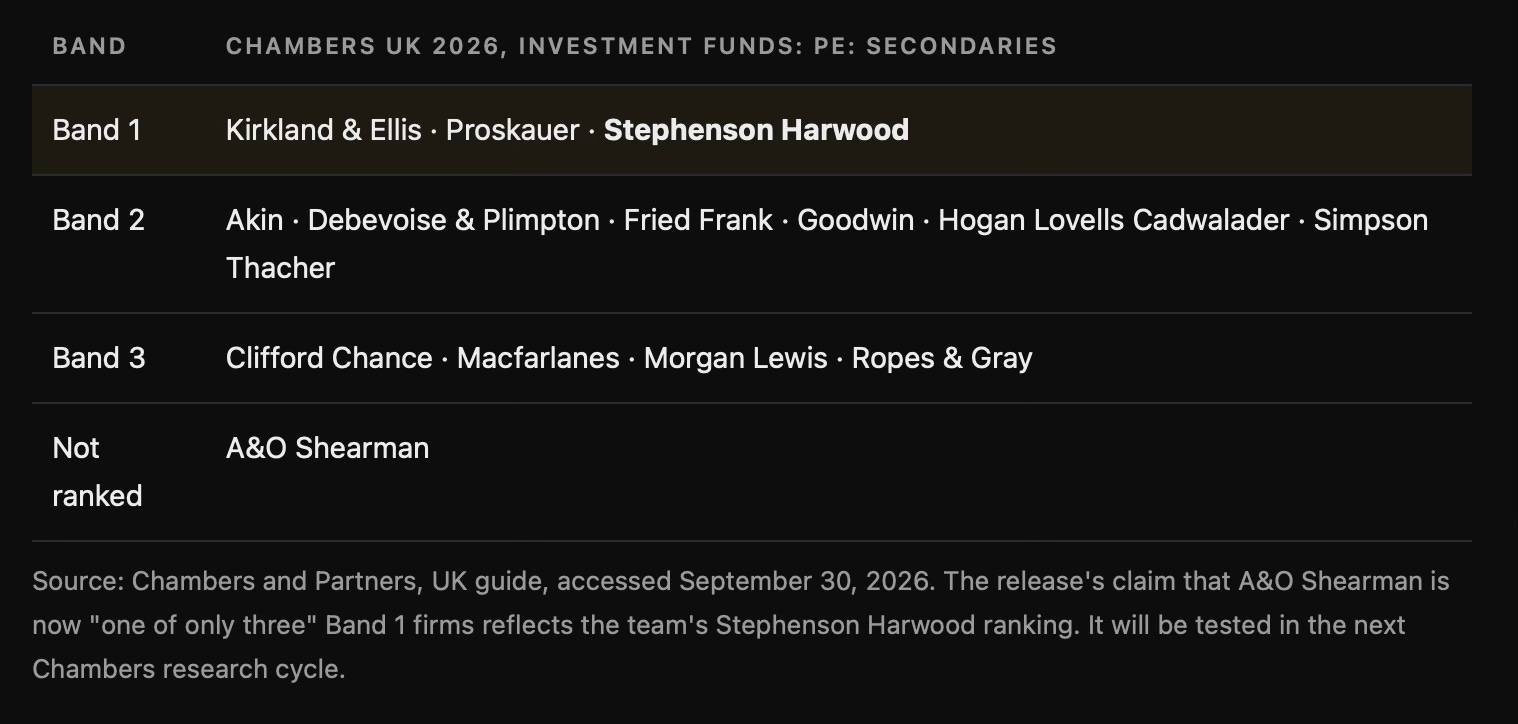
Chambers ranks departments and individuals. In the current UK secondaries table, A&O Shearman isn’t ranked at all, and Clifford Chance, in Band 3, is the only other legacy Magic Circle firm listed. Building from scratch would mean years of submissions and client referees before reaching the top band. Buying the team gives A&O Shearman a credible claim — though not yet a guarantee — to a Band 1 slot in the next edition.
4. The market won’t wait
Jefferies reported $290bn of dedicated secondaries capital at mid-2026 and said the market is on pace for another record year, after $240bn in 2025. A multi-year organic build would mean missing the steepest part of the growth curve. That’s the logic Boghossian put in one line:
“This is a strategic bet on the growth of our market.”
Gabriel Boghossian, incoming global co-head of secondaries, A&O Shearman
A&O Shearman’s leaders made the same point in client terms. UK managing partner Denise Gibson said clients had told the firm they needed market-leading secondaries capability. Peter Banks, global co-head of private equity, described GP-leds as a permanent capital channel that sponsors now routinely weigh among their exit options.
Whole team versus partner by partner
The form of the deal matters as much as the decision to buy. Weil has been building its secondaries platform one partner at a time: Simon Saitowitz returned in 2025, and Charles Cooper-Isow joined from Kirkland in April 2026. A&O Shearman took the entire practice, both co-leaders and, per the firm, the full team. A lift-out keeps working relationships, internal precedents and client coverage intact on day one. Its risk is concentration: the practice depends heavily on two people, and on clients choosing to follow them.
What the team brings
Stephenson Harwood’s published credentials point to a European, and heavily DACH, mid-market GP-led franchise. They list Ufenau’s continuation funds (about €1bn combined across Ufenau Continuation 3 and 4), DPE Deutsche Private Equity’s roughly €700m first continuation fund, BID Equity Continuation Fund I ($300m, 2025), Ardian Expansion’s Syclef continuation fund (€530m, 2024) and Astorg’s Normec fund (€1.44bn, 2024). On the LP side, they list ICG Enterprise Trust’s purchase of 175 tail-end fund interests from abrdn and a portfolio sale for Tesco Pension Trustees. The materials don’t consistently say which party the firm represented, so we present these as the team’s published experience, not specific mandates.