


ICG published its results for the six months to September 30 on November 11. Benoît Durteste, CIO and CEO, began the secondaries discussion by restating ICG’s place in the market: the firm is “still by far the largest player globally in strategic equity or GP-led secondaries.” He then explained how it uses that position.
“We’re turning down most of the deals we see to focus purely on exactly those very few deals…”
Benoît Durteste, CIO and CEO, ICG, H1 FY27 results call, November 11, 2026
He was specific about what ICG is rejecting. Many of the GP-leds in market, he said, come from sponsors seeking liquidity “that they cannot find at their NAV or their valuation in the primary market.” His view of those deals: “Those deals you do not really want to be doing.” The results deck says the same in shorter form. Under secondaries, it lists “unrealised private equity value supports origination, but selectivity is crucial.”
He also put the problem in terms of price:
“There is still an unresolved topic of valuations, which I believe remain too high for older vintages.”
Benoît Durteste, CIO and CEO, ICG, H1 FY27 results call
That comes from the largest buyer in the segment. The overhang of unrealized PE value is producing plenty of GP-led supply. In Durteste’s account, much of it is priced at marks that sponsors can’t get from primary buyers and that ICG won’t pay either.
The KKR question
In the Q&A, an analyst brought up the announcement that had dominated the GP-led conversation that week. KKR had said the day before that it would launch its first GP-led secondaries strategy in 2027.
Durteste didn’t name KKR in his answer. He described ICG as the first mover and the largest player, and said the firm is “incredibly selective.” Asked about the target for Strategic Equity VI, he said: “this is not something we are publicly discussing.” On timing: “the first close will be sometime during 2027, I could say.” He reminded analysts that the previous vintage totaled $11 billion. According to the results deck, that was $5.7 billion more than the vintage before it.
As we reported on November 10, KKR has said it expects to launch a GP-led strategy in 2027 but has not yet built the team or product. If both timelines hold, ICG’s next flagship and KKR’s first GP-led fund will be raising from the same LPs in the same year. ICG has the track record. KKR has a brand that is new to this market and a large base of perpetual capital. This overlap is our reading of the two firms’ public timelines. Neither firm has said it.
The numbers behind the discipline
ICG’s fund table shows why it can afford to say no, and why LPs will focus on cash returned.
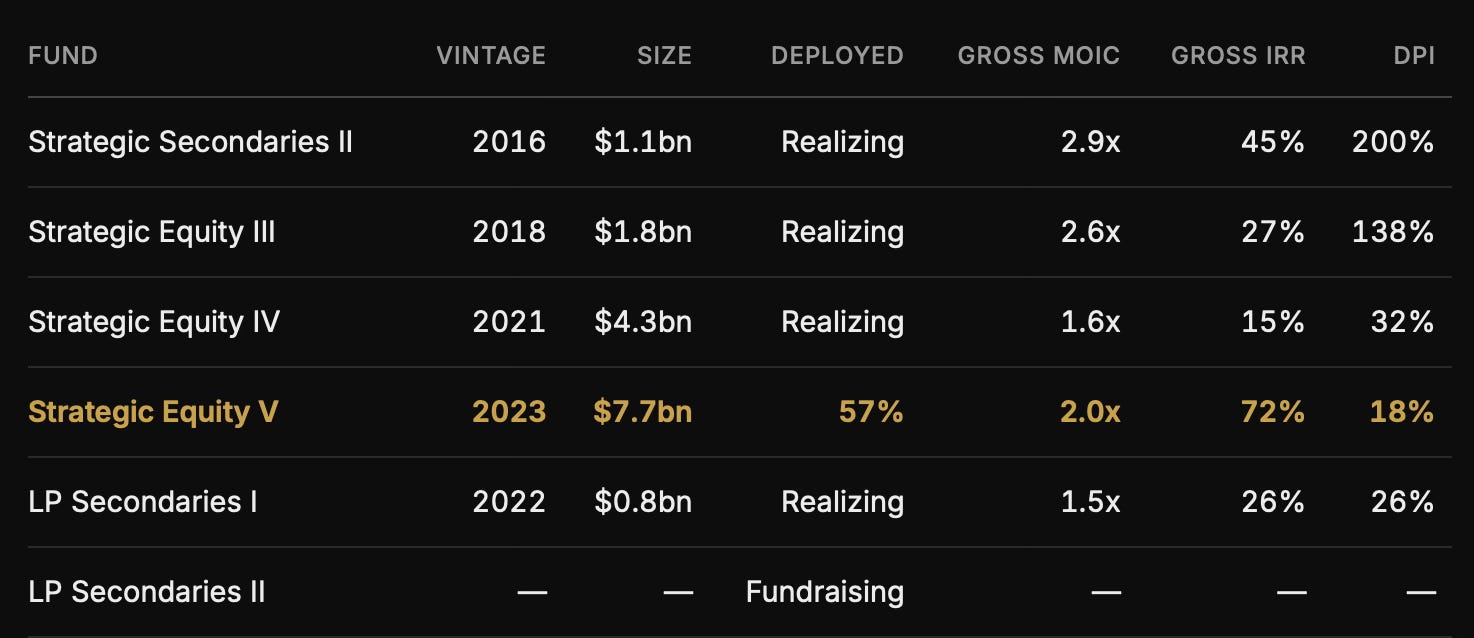
Source: ICG interim results statement, six months to September 30, 2026, “Performance of key funds.” Sizes are commingled fund only. ICG notes that fund performance is based on the latest practically available information and may not relate to the same period as the financial statements.
Strategic Equity V shows 2.0x gross MOIC and a 72% gross IRR with just over half its capital deployed. At that stage, IRR mostly reflects how quickly early marks have risen, not how the fund will end up. The 18% DPI is the figure that carries into the debate over early markups in GP-led funds. Further back, the record is mixed. The 2016 and 2018 vintages have returned 2.0x and 1.38x paid-in capital. Strategic Equity IV, at five years old and in realization, has returned 32% at a 1.6x gross mark.
READING ICG’S SECONDARIES DISCLOSURE
ICG runs two secondaries businesses under its Structured Capital and Secondaries segment. Strategic Equity is the GP-led flagship. LP Secondaries is the newer LP-led strategy, which ICG classes as “scaling.” Their combined fee-earning AUM is $17.1 billion.
Headline secondaries AUM rose to $30.4 billion from $24.0 billion. That jump is mostly an accounting change, not growth. From September 30, ICG includes unrealized gains on deployed assets in AUM ($16 billion group-wide) and has not restated prior periods. Fee-earning AUM is unaffected and is the comparable figure.
Fund sizes also come on two bases. The $7.7 billion for SE V is the commingled fund. The $11.0 billion in the results deck is the full program including SMAs and associated capital.
Between vintages
The half-year looks like a business waiting for its next fund. Fee-earning AUM in PE secondaries rose 2% year on year, against a 25% compound annual rate over five years. Strategic Equity deployed $0.4 billion in the six months and realized $0.1 billion. LP Secondaries deployed another $0.4 billion and raised $0.2 billion. PE secondaries earned £149 million of management fees over the last twelve months, so the business is a meaningful part of ICG’s fee base, but it isn’t growing right now.
ICG charges fees on committed capital when funds raise. So Strategic Equity’s next step-up in fee-earning AUM depends on a first close for SE VI, which Durteste has now placed somewhere in 2027. LP Secondaries II and ICG’s open-ended LP secondaries vehicles are raising in the meantime.
ICG is also putting less of its own money in. CFO David Bicarregui said that for Strategic Equity V “the balance sheet commitment halved from GBP 200 million to GBP 100 million,” even though SE V “was over twice the size of SE IV.” Across the recent fund vintages, total balance-sheet commitments fell by about £140 million, or 16%. This fits the new capital-allocation targets in the release: zero net debt over the medium term, with excess capital returned to shareholders. It also means ICG’s own exposure to its GP-led program is shrinking in relative terms as the funds get larger.
The wealth sleeve, slowly
Another analyst asked about the evergreen LP secondaries product launched with Amundi in October, which we covered on October 7. Durteste called it “really early days” and “a bit of a slow burn.” He also explained why ICG chose LP-leds, not GP-leds, for its first wealth product:
“LP secondaries is perfectly suitable for that space, because it has natural liquidity, because there is constant deal flow.”
Benoît Durteste, CIO and CEO, ICG, H1 FY27 results call, Q&A